
Just to let you loyal readers know, a new post is indeed in the works. It will be a photo essay of that wonderful Hungarian capital known as Budapest. I was there a few weeks ago for spring break and have been away from home quite a bit since school resumed.
April has just flown by, as, aside from being in Hungary for a week, I, along with those of my colleagues who still remain in Romania, attended our COS (Close of Service) Conference in Sinaia. I also spent time last week in Ploiesti, helping to train the new volunteers from Group 22. And to top it all off, I found myself in Constanta and Vama Veche this weekend, hanging with my friends on the Black Sea coast.
May will bring a trip to Bucharest for my final physical this week and a farewell trip to Piatra Neamt next week. Three solid weeks of school follow that and, well, that's all she wrote. As of June 2nd I will no longer be a PCV, but an RPCV. What a ride.
I'll be on the road for most of the month of June, solo and with my Dad. I'll be traveling to Serbia and Bosnia from the 2nd to the 10th: Belgrade, Sarajevo & Mostar. I'll pick up Dad at the airport in Bucharest on the 10th and take him to Codlea for a few days. I'll show him Brasov and let him adjust to the time change, etc. You know, take it easy a bit. On the 15th we'll fly out of Bucharest and embark on a 12-day tour of Slovenia, Croatia & Montenegro: Ljublijana, Zagreb, Split, Kotor & Dubrovnik. We'll be back on the 26th, stay in Romania for a few days, and then both fly out on July 1st. I will be back, for good, on American soil on Sunday afternoon, July 1st.
S0, that's my life in a nutshell for the next 8-9 weeks. I'm in the process of editing my Budapest photos, so please bear with me. I'll estimate that I'll have some pics up by this weekend. Until next time, be cool.
Monday, April 30, 2007


Saturday, April 07, 2007
The Beautiful Game
This post is dedicated to soccer, football, fotbal, futebol, fussball, etc. It doesn't matter where you come from or what language you speak, the "beautiful game" is played with style and finesse, toughness and grit, and is loved passionately all over the globe. Romanians are no exception to this rule. They can't live without their "fotbal". Kids play it anywhere and everywhere, no matter the conditions. When an important match is on, streets are empty and quiet, only to be interrupted by the celebratory roar after a goal. Public victory celebrations are the norm, and not just outside of the stadiums. In terms of league strength and national team competitiveness, Romanian soccer continues to climb the ladder of competition in Europe, a trend that should continue into the future.
As many loyal readers have probably figured out by now, I have become a big fan of soccer. I enjoyed and respected the game before I came to Romania, but it's different now. I understand it, I've seen it live at different levels of competition, I've lived through the ups and downs of a club season and national team competition, I've seen and felt the passion of the fans, etc. In short, I get it. Billions of fans can't be wrong. This American is convinced, soccer is indeed the world's game.
So, in this post I bring you some video and photo highlights of my soccer experience here in Romania, one aspect of my time here that I will truly miss. I'll have to get a Dish and Tivo. Dare to dream...
 The boys from the team at Hogas last year during an inter-school tournament in Piatra Neamt. They play a shortened, down-sized version of the game with less players on a concrete terrain that is a bit larger than a basketball court. It can be rough out there, with no real protection and bad footwear. I saw some pretty nasty scrapes that day out in front of the school.
 One of my former students, Mihai or Liviu, in action with the "gallery" watching in the background. As you may have noticed in the previous picture, he is one of a set of twins. I could never tell them apart, except for the fact that one of them was a goalkeeper. Both were great kids. Check out the action in the following video clip:
 Some die-hards cheering on my former hometown team, F.C. Ceahlaul Piatra Neamt. Ceahlaul competed in the 'B' Division during the '05-'06 season, thus attendance was sparse. However, they made the jump to 'Liga I' for the '06-'07 campaign and are now struggling to avoid demotion back to 'B' as they compete with the big boys like Steaua, Dinamo and Rapid. As a result of their promotion, their stadium received a major face lift and is now fit to host international competition. Romania hosted Luxembourg for a Euro 2008 qualifier there a few weeks ago and everything looked great. I barely recognized the place.
 Rough play or good acting? No matter, it's a yellow card for number 10 from Ceahlaul. 19 pleads his case in vain.
 FC Ceahaul action vs. FC Targoviste. Ceaulaul wound up winning that day.
 The old Ceahlaul logo. The club changed it after the jump to Liga I. This is unfortunate because they have a lot of tradition, dating back to 1919. Plus, I liked the old logo. It was unique. The new one is a bear or something. By the way, the club is named after the Ceahlaul Massif, a mountainous region in the area.
 Some soldiers on security detail. Who and/or what they're protecting is anybody's guess, as not many showed up for this game in May '06.
 Ceahlaul Stadium under the lights in May'06. As I mentioned earlier, the stadium has undergone major renovation. Thus, this view is a thing of the past.
 Football Club Brasov. As you can see, not a big draw. Nice stadium, no fans. They've been languishing in the 'B' Division for a few years now. Many are not pleased with this fact, as FC Brasov is a team with a lot of history and tradition. Combine this fact with the presence of the new upstart in town, Forex Brasov, a team that looks poised for promotion to Liga I, and, well, it's hard to put butts in the seats. Check out the following clip from their victory over F.C. Braila. Yawn.
 Great signs. I love that they're in English. "Come on Flag" has something to do with the former name of the club, which was associated with some sort of factory, "Steagul Rosie". Check out the "Mountain Sons" in the clip below, a 'B' division gallery in training. Not many of them, but they're having fun.
 Now that's loyalty.
 Dreaming of a return to Liga I...
 Alright, let's get down to business. September 2006, Dan Pelinescu stadium in Timisoara, capacity 30,000. One of the best stadiums in Liga I and home to F.C.U. Politechnica Timisoara, or better known as Poli Timisoara. Poli is my second favorite team and its fans are considered to be "brothers" with the fans of Rapid. If they're not playing Rapid, I root for Poli.
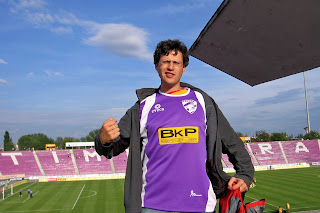 Geared up and ready for the match. "BkP" is Balkan Petroleum London, the team's major sponsor.
 The boys of Poli before the kickoff with Unirea Urziceni. Poli wound up winning 1-0 that evening. The gallery wasn't so big that day, but I was impressed nonetheless. Commando Viola Ultra Curva Sud. Check out the video clip:
 Attendance was around 5,000 that evening. Pretty good considering that the opponent wasn't of much interest. The stadium is packed when Steaua, Dinamo and Rapid come to town.
 April 1st, 2007, "America's number one Rapid fan"(as dubbed by his esteemed colleagues during an interview with Romania's Pro TV), undergoing pre-game preparation for the biggest derby of the season to date, Rapid vs. Steaua.
Rapid is my team. Of the three big Bucharest clubs, they're sort of the black sheep of the bunch. The stadium is in a not-so-nice part of town, and their fans are looked down upon by the elitist Dinamo and Steaua supporters, who don't hesitate to call them "gypsies". Rapid was founded as the rail workers club back in 1923 and its stadium is still owned by the Ministry of Transport. They're the blue collar team, a team with more history and tradition than Dinamo and Steaua, and have the most rabid and loyal fans.
Dinamo and Steaua were formed after communism took hold in the late 1940s. Dinamo was the securitate and police team and Steaua was the army team. These clubs both have a dubious past, as they used to apparently steal players at will from the other clubs, using threats of violence and intimidation. I've heard stories from the past of players and coaches being beaten and imprisoned for not doing the bidding of the thugs from Dinamo and Steaua. These days Dinamo is run by a psuedo-mafia conglomerate of "businessmen" and Steaua by one of Romania's most abhorrent personalities, Mr. George "Gigi" Becali. I love to watch Steaua lose and listen to Gigi whine about it during his infamous public tirades.
 That's right, I'm a season ticket holder.
 The One Man Invasion (OMI) showing us the way to Giulesti Stadium. A dream come true, two years in the making.
 The Giulesti Stadium Beer House. You know I'm gonna go.
 The OMI and Mr. Anderson. Forza Rapid, Muie Steaua!
 The OMI makes his long-awaited entrance into the gallery area of Giulesti stadium.
 Pre-game pose. We sat behind the north goal with the crazies, hooligans, superfans, or whatever you want to call them. We fit in perfectly. They're the cheap seats, but a whole lot of fun. See for yourself below...
 Hai Rapidul, Hai Rapidul , Haidei! Ole , ole, ole, ole, Rapid, Rapid!
 Most big clubs have a gallery leader, a superfan that leads the chants and cheers. His sound system is blasted into the gallery section and we are obliged to do his bidding. You don't want to get on his bad side.
I was fortunate to catch a couple of goals on video. The first clip is a goal by Cyril Thereau, a French national and forward for Steaua. He's one of the top scorers in Liga I. 1-0 Steaua.
This next clip is Rapid's second-half equalizer, an outstanding bicycle kick by Ianis Zicu, a member of the Romanian national team, in the 65th minute. 2-2 Rapid.
 Rapid lost that night, 2-3. It was up and down all night. Rapid gave up some stupid goals and should have won 2-1. To deal with the stress, everybody lit up, even the kids. They start them young here in Romania.
Depending on my schedule, I may or may not be able to attend some more games. No matter, as I've had a blast watching and talking soccer with the Romanians. I've definitely got the bug and will be frequenting the Chicago Fire matches for sure when I get home. Maybe one day I'll be able to see some big European clubs live at their home stadiums? 2010 World Cup in South Africa? All I know is that there's a lot of of "fotbal" to look forward to in the future.
As many loyal readers have probably figured out by now, I have become a big fan of soccer. I enjoyed and respected the game before I came to Romania, but it's different now. I understand it, I've seen it live at different levels of competition, I've lived through the ups and downs of a club season and national team competition, I've seen and felt the passion of the fans, etc. In short, I get it. Billions of fans can't be wrong. This American is convinced, soccer is indeed the world's game.
So, in this post I bring you some video and photo highlights of my soccer experience here in Romania, one aspect of my time here that I will truly miss. I'll have to get a Dish and Tivo. Dare to dream...
 The boys from the team at Hogas last year during an inter-school tournament in Piatra Neamt. They play a shortened, down-sized version of the game with less players on a concrete terrain that is a bit larger than a basketball court. It can be rough out there, with no real protection and bad footwear. I saw some pretty nasty scrapes that day out in front of the school.
 One of my former students, Mihai or Liviu, in action with the "gallery" watching in the background. As you may have noticed in the previous picture, he is one of a set of twins. I could never tell them apart, except for the fact that one of them was a goalkeeper. Both were great kids. Check out the action in the following video clip:
 Some die-hards cheering on my former hometown team, F.C. Ceahlaul Piatra Neamt. Ceahlaul competed in the 'B' Division during the '05-'06 season, thus attendance was sparse. However, they made the jump to 'Liga I' for the '06-'07 campaign and are now struggling to avoid demotion back to 'B' as they compete with the big boys like Steaua, Dinamo and Rapid. As a result of their promotion, their stadium received a major face lift and is now fit to host international competition. Romania hosted Luxembourg for a Euro 2008 qualifier there a few weeks ago and everything looked great. I barely recognized the place.
 Rough play or good acting? No matter, it's a yellow card for number 10 from Ceahlaul. 19 pleads his case in vain.
 FC Ceahaul action vs. FC Targoviste. Ceaulaul wound up winning that day.
 The old Ceahlaul logo. The club changed it after the jump to Liga I. This is unfortunate because they have a lot of tradition, dating back to 1919. Plus, I liked the old logo. It was unique. The new one is a bear or something. By the way, the club is named after the Ceahlaul Massif, a mountainous region in the area.
 Some soldiers on security detail. Who and/or what they're protecting is anybody's guess, as not many showed up for this game in May '06.
 Ceahlaul Stadium under the lights in May'06. As I mentioned earlier, the stadium has undergone major renovation. Thus, this view is a thing of the past.
 Football Club Brasov. As you can see, not a big draw. Nice stadium, no fans. They've been languishing in the 'B' Division for a few years now. Many are not pleased with this fact, as FC Brasov is a team with a lot of history and tradition. Combine this fact with the presence of the new upstart in town, Forex Brasov, a team that looks poised for promotion to Liga I, and, well, it's hard to put butts in the seats. Check out the following clip from their victory over F.C. Braila. Yawn.
 Great signs. I love that they're in English. "Come on Flag" has something to do with the former name of the club, which was associated with some sort of factory, "Steagul Rosie". Check out the "Mountain Sons" in the clip below, a 'B' division gallery in training. Not many of them, but they're having fun.
 Now that's loyalty.
 Dreaming of a return to Liga I...
 Alright, let's get down to business. September 2006, Dan Pelinescu stadium in Timisoara, capacity 30,000. One of the best stadiums in Liga I and home to F.C.U. Politechnica Timisoara, or better known as Poli Timisoara. Poli is my second favorite team and its fans are considered to be "brothers" with the fans of Rapid. If they're not playing Rapid, I root for Poli.
 Geared up and ready for the match. "BkP" is Balkan Petroleum London, the team's major sponsor.
 The boys of Poli before the kickoff with Unirea Urziceni. Poli wound up winning 1-0 that evening. The gallery wasn't so big that day, but I was impressed nonetheless. Commando Viola Ultra Curva Sud. Check out the video clip:
 Attendance was around 5,000 that evening. Pretty good considering that the opponent wasn't of much interest. The stadium is packed when Steaua, Dinamo and Rapid come to town.
 April 1st, 2007, "America's number one Rapid fan"(as dubbed by his esteemed colleagues during an interview with Romania's Pro TV), undergoing pre-game preparation for the biggest derby of the season to date, Rapid vs. Steaua.
Rapid is my team. Of the three big Bucharest clubs, they're sort of the black sheep of the bunch. The stadium is in a not-so-nice part of town, and their fans are looked down upon by the elitist Dinamo and Steaua supporters, who don't hesitate to call them "gypsies". Rapid was founded as the rail workers club back in 1923 and its stadium is still owned by the Ministry of Transport. They're the blue collar team, a team with more history and tradition than Dinamo and Steaua, and have the most rabid and loyal fans.
Dinamo and Steaua were formed after communism took hold in the late 1940s. Dinamo was the securitate and police team and Steaua was the army team. These clubs both have a dubious past, as they used to apparently steal players at will from the other clubs, using threats of violence and intimidation. I've heard stories from the past of players and coaches being beaten and imprisoned for not doing the bidding of the thugs from Dinamo and Steaua. These days Dinamo is run by a psuedo-mafia conglomerate of "businessmen" and Steaua by one of Romania's most abhorrent personalities, Mr. George "Gigi" Becali. I love to watch Steaua lose and listen to Gigi whine about it during his infamous public tirades.
 That's right, I'm a season ticket holder.
 The One Man Invasion (OMI) showing us the way to Giulesti Stadium. A dream come true, two years in the making.
 The Giulesti Stadium Beer House. You know I'm gonna go.
 The OMI and Mr. Anderson. Forza Rapid, Muie Steaua!
 The OMI makes his long-awaited entrance into the gallery area of Giulesti stadium.
 Pre-game pose. We sat behind the north goal with the crazies, hooligans, superfans, or whatever you want to call them. We fit in perfectly. They're the cheap seats, but a whole lot of fun. See for yourself below...
 Hai Rapidul, Hai Rapidul , Haidei! Ole , ole, ole, ole, Rapid, Rapid!
 Most big clubs have a gallery leader, a superfan that leads the chants and cheers. His sound system is blasted into the gallery section and we are obliged to do his bidding. You don't want to get on his bad side.
I was fortunate to catch a couple of goals on video. The first clip is a goal by Cyril Thereau, a French national and forward for Steaua. He's one of the top scorers in Liga I. 1-0 Steaua.
This next clip is Rapid's second-half equalizer, an outstanding bicycle kick by Ianis Zicu, a member of the Romanian national team, in the 65th minute. 2-2 Rapid.
 Rapid lost that night, 2-3. It was up and down all night. Rapid gave up some stupid goals and should have won 2-1. To deal with the stress, everybody lit up, even the kids. They start them young here in Romania.
Depending on my schedule, I may or may not be able to attend some more games. No matter, as I've had a blast watching and talking soccer with the Romanians. I've definitely got the bug and will be frequenting the Chicago Fire matches for sure when I get home. Maybe one day I'll be able to see some big European clubs live at their home stadiums? 2010 World Cup in South Africa? All I know is that there's a lot of of "fotbal" to look forward to in the future.
Friday, March 30, 2007
A Week on the Road, Part Four
Hi. I hope that you've enjoyed the "Week on the Road" post series. I now present to you the fourth and final part, my Ukrainian adventure...
Friday, February 9th
I woke up before my alarm rang, full of anticipation of the day that lie ahead. Julie and I decided that we'd cross the border into Ukraine on this day. Since the end of World War II it had been impossible to legally cross the border from Sighet. However, in mid-January of this year, just 3 weeks before my visit, President Traian Basescu of Romania and Ukrainian President Viktor Yuschenko met for a ribbon-cutting ceremony on the newly rebuilt bridge over the River Tisa (which had been bombed during the war), thus once again linking the 2 countries at this historic crossing point. I really had no idea what to expect. I didn't even know the name of the town across the border. All I knew was that I wanted to set my feet in uncharted territory.
The border crossing station was brand spanking new, with modern facilities manned by well-dressed, professional staff. We approached a border guard, told him that we wanted to cross and asked him if any other Americans had crossed at this location since the border opening. He informed us that we were numbers 4 and 5, as 3 had gone over in a car during the first week. However, we were to be the first Americans to cross on foot. Following a pleasant conversation and the obligatory passport stamping, we made our way onto the bridge and across the Tisa. Once we crossed the yellow dividing line pained on the bridge, things began to change.
It was foggy, cold and wet that day, so it was impossible to see the Ukrainian side until we were well past the dividing line. As we approached, the first thing I noticed was a large blue and yellow sign in cyrillic. Welcome to Ukraine - burly blond, blue-eyed border guards and sounds of a language I had only heard in movies and on television, etc. I was nervous and felt like I was in a kind of no man's land, a very foreign and potentially dangerous world, albeit for a few hours.
I tried to speak to the customs officer in English. That didn't go so well. We didn't fill out the entry form correctly. We fixed the problem and went back for a second try. As we made our way back to his area, I heard him speaking Romanian. What a relief. I politely apologized for not using Romanian in the first place and he seemed happy that he could now communicate with me. "Alright.", I thought, "This isn't going to be so difficult after all. He stamped my passport and I moved to the inspection area.
Things weren't so cordial at this stage. These guys didn't speak English or Romanian and were a bit thuggish. I emptied my pockets and put my camera and umbrella on the table. One said to me, "Bani". I looked at him, surprised, and said, "Bani?". "Money", he said. "Money?", I replied. "Euros, dollars, money", he stated firmly, gesturing so that I understood that he wanted to know if I was carrying any cash. Clearly these were the only words he new in English or Romanian, and important ones at that, no? I said, "Money? Yes, yes." He grinned and waited with anticipation, probably thinking I'd be easy pickings for a bribe. "I only have Romanian Lei", I said, and this was the truth. He stared me down for a bit and, disappointed, let me go. Clearly he was perplexed. How could the American "tourist" not be carrying Euros or Dollars? Score one for me.
Julie got through and off we went to the town of Solotvyna, or to the Romanians, Slatina, population 9,000 (approx.). At first glimpse, things didn't look much different than in Romania. However, as we walked further away from the border and deeper into the town, it became apparent that we had entered a different land. Poverty was more visible. The people looked even more worn-out and down-trodden than small-town Romanians. I geared up for the stares as we walked, and boy did we get them.
We observed that people were speaking Romanian on the streets, so I asked this old dude on a bike where the center of town was. With a thick Russian-like accent, he said to me, in Romanian, "this is the center of town". Ah. Okay, cool. The town center consisted of a Ukrainian Orthodox church (which was locked), a park in front of a Romanian-language school and a handful of shops and grocery stores/bars/cafeterias. I honestly believe, especially after talking to the shopkeepers and a couple of people on the street (80% speak Romanian), that we were the first Americans to ever take a stroll in "downtown" Slatina.
First stop was the ATM. We didn't know the exchange rate, so when posed with the decision as to how much money to withdraw, we hadn't a clue. Julie went first. She used her Romanian bankcard, an account containing only Lei. She took out 50 whatever-you-call-thems. I withdrew 100. We walked a bit further up the street and found a bank with exchange rates posted in the window. It was 5 to 1 Ukrainian/USD, so that meant it was roughly 2.5 to 1 Ukrainian/Lei. That being said, stuff was cheap.
We checked out a few stores, one of which had goods strewn about the floor in crates and a long line of old women in babushkas waiting silently to buy their groceries. The place smelled like wet, moldy socks. It was a scene straight out of the Soviet Union. Needless to say, we got the hell out of there and found a better smelling and more professional looking operation. I bought some chocolate. One bar with Red Square on it and another with a Ukrainian peasant girl named Alionka. We found another grocery store. This one had a bar with two beer taps and some tables and chairs. Score.
The barman/owner couldn't believe that 1) there were Americans in his establishment and 2) that we spoke Romanian. I had to show him my passport to convince him. Suspicions now set aside (sort of), he set us up with a couple of pints of solid Rogan lager, some stale bread and bowls of Ukrainian borscht. The borscht wasn't much different than certain kinds of Romanian soups. It contained beets, carrots, cabbage, potatoes, beef, oil and a dollop of sour cream. It was your standard Ukrainian borscht. As we ate, one by one people would come in, sit down and start to whisper and look at us. When we we getting ready to leave, someone got up the courage to speak to us. We conversed in Romanian with the owner, the cook and some others. We told them who we were and where we came from. They were incredulous. Really. We must have been the first Americans they had ever seen and/or spoken to in person. We bought some beers to take back with us, hit the road and headed across the park to the school.
Of course, we just walked in. We didn't see any teachers and the few kids we saw in the halls simply stared, whispered and giggled. We felt right at home. The halls were cold, drab and empty. We went up to to the third floor and peered out a window looking out onto the back courtyard. There was a wheelbarrow and shovel parked next to a HUGE pile of coal, out in the open. Obviously this was the school's source of heat and, hopefully, a disciplinary tool. I certainly would love to make some of my little darlings go out to the back of the school and shovel coal if they've been misbehaving. Damn natural gas. I should have done PC Ukraine. Seriously though, it was all so surreal, I felt like I was in a time warp. After seeing the coal pile, we realized that the strange smell that hung in the air was from the plethora of coal-burning furnaces in town. Romanians use wood as an alternative to natural gas. I've never encountered any houses or buildings here that burn coal for heat.
Our final stop was a liquor store. The woman inside was super friendly and spoke Romanian without a heavy accent. I said I wanted a bottle of something "very Ukrainian" to take back with me, something akin to the national drink. She smiled and pulled a bottle off the shelf. Nemiroff Vodka with hot peppers floating in it and a touch of honey. Hot and sweet vodka. Nice. I'll take it. The 750 ml bottle cost me about the equivalent of US $3.50. What a deal. We talked a bit about the town and she encouraged us to come back and visit the museum. I could only imagine what that's like. We got some info. about transport to Kiev and Lviv, as I was curious about travel times to these cities. They were entirely too long of course. We exchanged pleasantries and said goodbye. Again, it was so great that we were able to communicate with people in town. We only encountered two people that day who didn't speak Romanian, one of whom only spoke Hungarian!
On our way back to the border we came across a Ukrainian television crew interviewing people as they came in from Romania. I had to get back across the border, as I still had to pack and catch a train later that afternoon, but I couldn't resist the chance to speak with them. I approached them, and in Romanian said, "Hi, we're Americans". The looks on their faces were priceless. They paused, stared, and after regaining their wits motioned excitedly for us to come talk to them. They interviewed Julie and I for about 10 minutes. The television audience probably had never seen anything like it. Two Americans, out for a day of shopping and sightseeing in Slatina during the dead of winter, speaking Romanian on a Ukrainian news broadcast. Awesome. Julie and I were true pioneers that day. And back we went with sacks full of beer, vodka and chocolate, problem and hassle-free.
I hopped on the train back to Brasov around 5:30pm. It was a night train that got in around 4am. I shared a sleeper cabin with some gypsy dude from Bucharest, a perfume salesman/smuggler. It was a furnace in that compartment. We were burning up. The gypsy dude couldn't take it anymore and had to take his shirt off. He smelled, and the whole trip was pretty awful. Just another day on the CFR (Romanian Railways).
What a trip. I saw and experienced things that were truly new and unique to me, things that most Americans never do. I want to go back to Maramures someday and explore the villages when the weather is nice. I also must go back to Ukraine, maybe to Lviv or Kiev and definitely to Slatina. Most of all, I want to go back to that liquor store and grocery/bar and chat with all of the friendly Ukrainians I met that day. They changed my world, my perspective, and I think we did the same for them. They're going to see more and more visitors from the West as spring and summer comes. The new border crossing is going to change their lives in a big way. I hope that they never forget us, the Romanian-speaking Americans who came to Slatina one rainy winter day in February. I'll surely never forget them.
 The border crossing at Sighet.
 Julie can't believe that she's about to leave "home". Yes, the former Soviet Union is just across that bridge.
 The mighty river Tisa.
 Welcome to Ukraine comrade.
 Borscht and beer. Hits the spot on a cold, rainy winter afternoon in Ukraine.
 Welcome to the Romanian school. I should have taken a photo of the coal pile out back. That was the one that got away.
 This was on the wall in the hallway. I believe that this is something about Maramures, based on the costumes and hay bales. However, I do not read cyrillic.
 I liked this one. Maybe something about the good 'ole Red Army?
 In the park with some sort of Soviet-era WW-II memorial. My Belarussian blood compelled me to salute.
 Shopping bag full, Julie's ready to go back across. But not before...
 ...we talk to the TV crew. Check out their cool little Lada 4x4 in the background.
 The border approach, Ukrainian side.
 Yes, I really was there.
 Yes, I took out too much currency. But check out my cool "wallet".
 Back home in Codlea with Alionka and Nemiroff.
Friday, February 9th
I woke up before my alarm rang, full of anticipation of the day that lie ahead. Julie and I decided that we'd cross the border into Ukraine on this day. Since the end of World War II it had been impossible to legally cross the border from Sighet. However, in mid-January of this year, just 3 weeks before my visit, President Traian Basescu of Romania and Ukrainian President Viktor Yuschenko met for a ribbon-cutting ceremony on the newly rebuilt bridge over the River Tisa (which had been bombed during the war), thus once again linking the 2 countries at this historic crossing point. I really had no idea what to expect. I didn't even know the name of the town across the border. All I knew was that I wanted to set my feet in uncharted territory.
The border crossing station was brand spanking new, with modern facilities manned by well-dressed, professional staff. We approached a border guard, told him that we wanted to cross and asked him if any other Americans had crossed at this location since the border opening. He informed us that we were numbers 4 and 5, as 3 had gone over in a car during the first week. However, we were to be the first Americans to cross on foot. Following a pleasant conversation and the obligatory passport stamping, we made our way onto the bridge and across the Tisa. Once we crossed the yellow dividing line pained on the bridge, things began to change.
It was foggy, cold and wet that day, so it was impossible to see the Ukrainian side until we were well past the dividing line. As we approached, the first thing I noticed was a large blue and yellow sign in cyrillic. Welcome to Ukraine - burly blond, blue-eyed border guards and sounds of a language I had only heard in movies and on television, etc. I was nervous and felt like I was in a kind of no man's land, a very foreign and potentially dangerous world, albeit for a few hours.
I tried to speak to the customs officer in English. That didn't go so well. We didn't fill out the entry form correctly. We fixed the problem and went back for a second try. As we made our way back to his area, I heard him speaking Romanian. What a relief. I politely apologized for not using Romanian in the first place and he seemed happy that he could now communicate with me. "Alright.", I thought, "This isn't going to be so difficult after all. He stamped my passport and I moved to the inspection area.
Things weren't so cordial at this stage. These guys didn't speak English or Romanian and were a bit thuggish. I emptied my pockets and put my camera and umbrella on the table. One said to me, "Bani". I looked at him, surprised, and said, "Bani?". "Money", he said. "Money?", I replied. "Euros, dollars, money", he stated firmly, gesturing so that I understood that he wanted to know if I was carrying any cash. Clearly these were the only words he new in English or Romanian, and important ones at that, no? I said, "Money? Yes, yes." He grinned and waited with anticipation, probably thinking I'd be easy pickings for a bribe. "I only have Romanian Lei", I said, and this was the truth. He stared me down for a bit and, disappointed, let me go. Clearly he was perplexed. How could the American "tourist" not be carrying Euros or Dollars? Score one for me.
Julie got through and off we went to the town of Solotvyna, or to the Romanians, Slatina, population 9,000 (approx.). At first glimpse, things didn't look much different than in Romania. However, as we walked further away from the border and deeper into the town, it became apparent that we had entered a different land. Poverty was more visible. The people looked even more worn-out and down-trodden than small-town Romanians. I geared up for the stares as we walked, and boy did we get them.
We observed that people were speaking Romanian on the streets, so I asked this old dude on a bike where the center of town was. With a thick Russian-like accent, he said to me, in Romanian, "this is the center of town". Ah. Okay, cool. The town center consisted of a Ukrainian Orthodox church (which was locked), a park in front of a Romanian-language school and a handful of shops and grocery stores/bars/cafeterias. I honestly believe, especially after talking to the shopkeepers and a couple of people on the street (80% speak Romanian), that we were the first Americans to ever take a stroll in "downtown" Slatina.
First stop was the ATM. We didn't know the exchange rate, so when posed with the decision as to how much money to withdraw, we hadn't a clue. Julie went first. She used her Romanian bankcard, an account containing only Lei. She took out 50 whatever-you-call-thems. I withdrew 100. We walked a bit further up the street and found a bank with exchange rates posted in the window. It was 5 to 1 Ukrainian/USD, so that meant it was roughly 2.5 to 1 Ukrainian/Lei. That being said, stuff was cheap.
We checked out a few stores, one of which had goods strewn about the floor in crates and a long line of old women in babushkas waiting silently to buy their groceries. The place smelled like wet, moldy socks. It was a scene straight out of the Soviet Union. Needless to say, we got the hell out of there and found a better smelling and more professional looking operation. I bought some chocolate. One bar with Red Square on it and another with a Ukrainian peasant girl named Alionka. We found another grocery store. This one had a bar with two beer taps and some tables and chairs. Score.
The barman/owner couldn't believe that 1) there were Americans in his establishment and 2) that we spoke Romanian. I had to show him my passport to convince him. Suspicions now set aside (sort of), he set us up with a couple of pints of solid Rogan lager, some stale bread and bowls of Ukrainian borscht. The borscht wasn't much different than certain kinds of Romanian soups. It contained beets, carrots, cabbage, potatoes, beef, oil and a dollop of sour cream. It was your standard Ukrainian borscht. As we ate, one by one people would come in, sit down and start to whisper and look at us. When we we getting ready to leave, someone got up the courage to speak to us. We conversed in Romanian with the owner, the cook and some others. We told them who we were and where we came from. They were incredulous. Really. We must have been the first Americans they had ever seen and/or spoken to in person. We bought some beers to take back with us, hit the road and headed across the park to the school.
Of course, we just walked in. We didn't see any teachers and the few kids we saw in the halls simply stared, whispered and giggled. We felt right at home. The halls were cold, drab and empty. We went up to to the third floor and peered out a window looking out onto the back courtyard. There was a wheelbarrow and shovel parked next to a HUGE pile of coal, out in the open. Obviously this was the school's source of heat and, hopefully, a disciplinary tool. I certainly would love to make some of my little darlings go out to the back of the school and shovel coal if they've been misbehaving. Damn natural gas. I should have done PC Ukraine. Seriously though, it was all so surreal, I felt like I was in a time warp. After seeing the coal pile, we realized that the strange smell that hung in the air was from the plethora of coal-burning furnaces in town. Romanians use wood as an alternative to natural gas. I've never encountered any houses or buildings here that burn coal for heat.
Our final stop was a liquor store. The woman inside was super friendly and spoke Romanian without a heavy accent. I said I wanted a bottle of something "very Ukrainian" to take back with me, something akin to the national drink. She smiled and pulled a bottle off the shelf. Nemiroff Vodka with hot peppers floating in it and a touch of honey. Hot and sweet vodka. Nice. I'll take it. The 750 ml bottle cost me about the equivalent of US $3.50. What a deal. We talked a bit about the town and she encouraged us to come back and visit the museum. I could only imagine what that's like. We got some info. about transport to Kiev and Lviv, as I was curious about travel times to these cities. They were entirely too long of course. We exchanged pleasantries and said goodbye. Again, it was so great that we were able to communicate with people in town. We only encountered two people that day who didn't speak Romanian, one of whom only spoke Hungarian!
On our way back to the border we came across a Ukrainian television crew interviewing people as they came in from Romania. I had to get back across the border, as I still had to pack and catch a train later that afternoon, but I couldn't resist the chance to speak with them. I approached them, and in Romanian said, "Hi, we're Americans". The looks on their faces were priceless. They paused, stared, and after regaining their wits motioned excitedly for us to come talk to them. They interviewed Julie and I for about 10 minutes. The television audience probably had never seen anything like it. Two Americans, out for a day of shopping and sightseeing in Slatina during the dead of winter, speaking Romanian on a Ukrainian news broadcast. Awesome. Julie and I were true pioneers that day. And back we went with sacks full of beer, vodka and chocolate, problem and hassle-free.
I hopped on the train back to Brasov around 5:30pm. It was a night train that got in around 4am. I shared a sleeper cabin with some gypsy dude from Bucharest, a perfume salesman/smuggler. It was a furnace in that compartment. We were burning up. The gypsy dude couldn't take it anymore and had to take his shirt off. He smelled, and the whole trip was pretty awful. Just another day on the CFR (Romanian Railways).
What a trip. I saw and experienced things that were truly new and unique to me, things that most Americans never do. I want to go back to Maramures someday and explore the villages when the weather is nice. I also must go back to Ukraine, maybe to Lviv or Kiev and definitely to Slatina. Most of all, I want to go back to that liquor store and grocery/bar and chat with all of the friendly Ukrainians I met that day. They changed my world, my perspective, and I think we did the same for them. They're going to see more and more visitors from the West as spring and summer comes. The new border crossing is going to change their lives in a big way. I hope that they never forget us, the Romanian-speaking Americans who came to Slatina one rainy winter day in February. I'll surely never forget them.
Photo Highlights
 The border crossing at Sighet.
 Julie can't believe that she's about to leave "home". Yes, the former Soviet Union is just across that bridge.
 The mighty river Tisa.
 Welcome to Ukraine comrade.
 Borscht and beer. Hits the spot on a cold, rainy winter afternoon in Ukraine.
 Welcome to the Romanian school. I should have taken a photo of the coal pile out back. That was the one that got away.
 This was on the wall in the hallway. I believe that this is something about Maramures, based on the costumes and hay bales. However, I do not read cyrillic.
 I liked this one. Maybe something about the good 'ole Red Army?
 In the park with some sort of Soviet-era WW-II memorial. My Belarussian blood compelled me to salute.
 Shopping bag full, Julie's ready to go back across. But not before...
 ...we talk to the TV crew. Check out their cool little Lada 4x4 in the background.
 The border approach, Ukrainian side.
 Yes, I really was there.
 Yes, I took out too much currency. But check out my cool "wallet".
 Back home in Codlea with Alionka and Nemiroff.
Sunday, March 11, 2007
A Week on the Road, Part Three
Thursday, February 8th
After a breakfast of eggs and pancakes (again, thanks to Julie), Julie and I headed over to her school to meet up with her counterpart Anuta. Anuta volunteered to take us to the "Merry Cemetery" in the village of Sapanta, located about 16km west of Sighet. Despite the rain and generally poor weather, we managed to squeeze in a couple of other sights as well.
Julie's got it rough. So do her students. After seeing the conditions she has to endure at school I've got no right to complain. The entire school is heated by wood. Every room has its own individual wood burning stove, or soba, and accompanying woodpile. Every morning, starting at 4, the cleaning ladies light the sobas and replenish the woodpiles. I'd like to mention that this is by no means a small school. It's a turn of the 20th century three-story building located in the center of the city. I saw the biggest pile of firewood in my life when I went into the back courtyard of the school. No joke.
Her classroom is a mish-mosh of rickety furniture, splintered floorboards, and a barely functioning soba. She teaches in a hat, coat and scarf most winter days. These conditions, while unpleasant, are tolerable. However, what is intolerable is the students' outdoor latrine. Total and utter squalor. Non-flush Turkish toilets, cracked concrete, holes in the roof, no doors on the stalls and overgrown with weeds. Filth, trash and cigarette butts are everywhere. I'd have to imagine that the local homeless/drunks use this latrine at will. I've grown to be quite tolerant of the poor conditions that exist in the schools here, but this situation is absolutely unacceptable. It is a shame that such 3rd world conditions still exist here, especially in a school in the center of a city.
Anuta arrived and we departed around 12:30pm for Sapanta. 30 minutes later we passed through the colorful, hand-painted town gate. Maramures is famous for its elaborately carved (and sometimes painted) wooden architecture, something that I appreciate very much. Anuta was born and raised in Sapanta and is the author of a bilingual tourism book about the town and surrounding area, the perfect guide for a day of sightseeing. We didn't have to pay admission to the cemetery. Nice hook up.
Cimitirul Vesel or "The Merry Cemetery" is something special. Back in the 1930's, a man named Stan Ioan Patras began designing, carving and painting unique headstones (they're wooden) that depict the deceased in scenes that represent who they were and/or the circumstances surrounding their death. Each has a poem about the person's life, many of which are witty and humorous, no matter how the person met their maker. However, I did encounter my fair share of sad ones. The creativity and craftsmanship that went into (and still does today) these wooden headstones is unlike anything I've ever seen. Patras died in the 1970's, but passed on his craft to his apprentices, who now also have their own apprentices. The tradition is alive and well, as the cemetery still accepts residents and, well, business is good. The Merry Cemetery is truly unique, an important contribution to European folk art. I hope to visit again and spend more time there. Anuta gave us a first-class tour.
After buying a few souvenirs, like a good tourist always should, we escaped the rain and Anuta drove us to see the wooden church at the Sapanta-Peri Monastery. It is the tallest wooden church in the world. However, interior construction has yet to finish and it may take a few more years. The wooden churches of Maramures are another unique element of the landscape and culture of the area and many are under protection by UNESCO. The craftsmanship that went into the Sapanta-Peri church is extraordinary, particularly a staircase carved out of a single, large oak tree. Super cool.
We drove back to Sighet and Anuta treated us to a tasty lunch of vegetable soup, cheese, sausages and pork medallions with sauteed carrots and cabbage. After the obligatory Palinka (no Tuica around these parts), we wolfed down lunch and set off southeast to the monastic complex at Barsana.
The drive was great. I had the opportunity to see many styles and sizes of wooden gates on the homes that lined the road, some big, some small, some old, some new and all interesting. Looking around, it appeared that village life in Maramures is more traditional than in other rural parts of Romania I've visited. The snow-covered, forested hills were a beautiful backdrop to the scenes immediately in front of me. I could only imagine how captivating the area must be in the summertime.
The Barsana complex was completed in 1993 or 94 and houses a group of nuns that work there and maintain the grounds. Its wooden church is stunning. The ground floor altar room was dimly lit, with daylight piercing through small, rectangular windows. It felt very Crypt-like. Iconic paintings covered the wood walls and ceilings and a small model of the church sat on the altar, illuminated by a single candle. It was so silent and peaceful in there, truly a place for meditation, prayer and reflection.
It was getting dark, so after the church we had a quick look around the grounds and headed back to Sighet. On the way out I saw the coolest gate ornament suspended above an entryway, the Romania Coat of Arms carved from wood. I'd love to get one someday and have it painted to the exact specifications of the actual coat of arms.
Anuta gave me a signed copy of her book, gave us a goodbye kiss and dropped us off near Julie's apartment. We played cards again, drank some beer and went to bed around midnight.

After a breakfast of eggs and pancakes (again, thanks to Julie), Julie and I headed over to her school to meet up with her counterpart Anuta. Anuta volunteered to take us to the "Merry Cemetery" in the village of Sapanta, located about 16km west of Sighet. Despite the rain and generally poor weather, we managed to squeeze in a couple of other sights as well.
Julie's got it rough. So do her students. After seeing the conditions she has to endure at school I've got no right to complain. The entire school is heated by wood. Every room has its own individual wood burning stove, or soba, and accompanying woodpile. Every morning, starting at 4, the cleaning ladies light the sobas and replenish the woodpiles. I'd like to mention that this is by no means a small school. It's a turn of the 20th century three-story building located in the center of the city. I saw the biggest pile of firewood in my life when I went into the back courtyard of the school. No joke.
Her classroom is a mish-mosh of rickety furniture, splintered floorboards, and a barely functioning soba. She teaches in a hat, coat and scarf most winter days. These conditions, while unpleasant, are tolerable. However, what is intolerable is the students' outdoor latrine. Total and utter squalor. Non-flush Turkish toilets, cracked concrete, holes in the roof, no doors on the stalls and overgrown with weeds. Filth, trash and cigarette butts are everywhere. I'd have to imagine that the local homeless/drunks use this latrine at will. I've grown to be quite tolerant of the poor conditions that exist in the schools here, but this situation is absolutely unacceptable. It is a shame that such 3rd world conditions still exist here, especially in a school in the center of a city.
Anuta arrived and we departed around 12:30pm for Sapanta. 30 minutes later we passed through the colorful, hand-painted town gate. Maramures is famous for its elaborately carved (and sometimes painted) wooden architecture, something that I appreciate very much. Anuta was born and raised in Sapanta and is the author of a bilingual tourism book about the town and surrounding area, the perfect guide for a day of sightseeing. We didn't have to pay admission to the cemetery. Nice hook up.
Cimitirul Vesel or "The Merry Cemetery" is something special. Back in the 1930's, a man named Stan Ioan Patras began designing, carving and painting unique headstones (they're wooden) that depict the deceased in scenes that represent who they were and/or the circumstances surrounding their death. Each has a poem about the person's life, many of which are witty and humorous, no matter how the person met their maker. However, I did encounter my fair share of sad ones. The creativity and craftsmanship that went into (and still does today) these wooden headstones is unlike anything I've ever seen. Patras died in the 1970's, but passed on his craft to his apprentices, who now also have their own apprentices. The tradition is alive and well, as the cemetery still accepts residents and, well, business is good. The Merry Cemetery is truly unique, an important contribution to European folk art. I hope to visit again and spend more time there. Anuta gave us a first-class tour.
After buying a few souvenirs, like a good tourist always should, we escaped the rain and Anuta drove us to see the wooden church at the Sapanta-Peri Monastery. It is the tallest wooden church in the world. However, interior construction has yet to finish and it may take a few more years. The wooden churches of Maramures are another unique element of the landscape and culture of the area and many are under protection by UNESCO. The craftsmanship that went into the Sapanta-Peri church is extraordinary, particularly a staircase carved out of a single, large oak tree. Super cool.
We drove back to Sighet and Anuta treated us to a tasty lunch of vegetable soup, cheese, sausages and pork medallions with sauteed carrots and cabbage. After the obligatory Palinka (no Tuica around these parts), we wolfed down lunch and set off southeast to the monastic complex at Barsana.
The drive was great. I had the opportunity to see many styles and sizes of wooden gates on the homes that lined the road, some big, some small, some old, some new and all interesting. Looking around, it appeared that village life in Maramures is more traditional than in other rural parts of Romania I've visited. The snow-covered, forested hills were a beautiful backdrop to the scenes immediately in front of me. I could only imagine how captivating the area must be in the summertime.
The Barsana complex was completed in 1993 or 94 and houses a group of nuns that work there and maintain the grounds. Its wooden church is stunning. The ground floor altar room was dimly lit, with daylight piercing through small, rectangular windows. It felt very Crypt-like. Iconic paintings covered the wood walls and ceilings and a small model of the church sat on the altar, illuminated by a single candle. It was so silent and peaceful in there, truly a place for meditation, prayer and reflection.
It was getting dark, so after the church we had a quick look around the grounds and headed back to Sighet. On the way out I saw the coolest gate ornament suspended above an entryway, the Romania Coat of Arms carved from wood. I'd love to get one someday and have it painted to the exact specifications of the actual coat of arms.
Anuta gave me a signed copy of her book, gave us a goodbye kiss and dropped us off near Julie's apartment. We played cards again, drank some beer and went to bed around midnight.
Photo Highlights:

School latrine shot #1. I think it speaks for itself.

Same here.

Julie getting warm with the giant soba in the canceliare (teacher's lounge).

The entry gate to the Merry Cemetery, Sapanta.

A giant wooden cross on the street in front of the cemetery with the orthodox church in the background.

Inside the Merry Cemetery.

Here lies the creator. Stan was indeed the Man.

This guy liked to drive his tractor. A "tractorist", as we say in Romania.

This dude was a forestry worker. Apparently he was fond of his chainsaw.

A peaceful life spent picking apple trees for this fella.

One of my favorites. This guy loved to sit at the table, hold court and drink with his homeboys.

Uhh. Not exactly sure what's going on here. It is technically an art piece, so I'll leave it up to interpretation.

Oh man. Those of you who can read Romanian will appreciate this one. Click for a bigger view so you can read the story. The streets are not a safe place for little kids.

Apparently this poor lady died from some sort of machinery fire, a loom or something.

I think we know what happened here.

Me thinking about how I'm gonna get my own Sapanta headstone someday.

The church at Sapanta-Peri Monastery.

Here's the staircase I was talking about. That was a big tree.

The entry gate to the Barsana Monastic Complex.

Inside Barsana.

The church at Barsana.

The altar at the bottom of the church.

School latrine shot #1. I think it speaks for itself.

Same here.

Julie getting warm with the giant soba in the canceliare (teacher's lounge).

The entry gate to the Merry Cemetery, Sapanta.

A giant wooden cross on the street in front of the cemetery with the orthodox church in the background.

Inside the Merry Cemetery.

Here lies the creator. Stan was indeed the Man.

This guy liked to drive his tractor. A "tractorist", as we say in Romania.

This dude was a forestry worker. Apparently he was fond of his chainsaw.

A peaceful life spent picking apple trees for this fella.

One of my favorites. This guy loved to sit at the table, hold court and drink with his homeboys.

Uhh. Not exactly sure what's going on here. It is technically an art piece, so I'll leave it up to interpretation.

Oh man. Those of you who can read Romanian will appreciate this one. Click for a bigger view so you can read the story. The streets are not a safe place for little kids.

Apparently this poor lady died from some sort of machinery fire, a loom or something.

I think we know what happened here.

Me thinking about how I'm gonna get my own Sapanta headstone someday.

The church at Sapanta-Peri Monastery.

Here's the staircase I was talking about. That was a big tree.

The entry gate to the Barsana Monastic Complex.

Inside Barsana.

The church at Barsana.

The altar at the bottom of the church.

The Romanian Coat of Arms in wood. Like I said, someday I must have one, and it will be painted.
Subscribe to:
Posts (Atom)


