
That's all she wrote. I officially checked out of the Peace Corps this afternoon. However, this doesn't mean the end of "Fenblog". There's much more to come. Stay tuned for:
- Budapest (parts 1-4)
- Summer travels in: Serbia, Bosnia, Slovenia, Croatia, & Montenegro
- Bucharest
- Timisoara
- Mountains
- Animals
- Iron Curtain Autos. part 2
- and everything else I never had time to post...
I'd like to say that, despite all of the hardships, I'd do it again in a heartbeat. Two years ago, I saw the Peace Corps as being the ultimate challenge, the fulfillment of a dream. It was both of those and then some.
I'll close by dedicating this post to the love of my life and my future wife. We hung tough and stuck together. Everything else is gonna be a piece of cake. I love you Sarah Barr. I'll be home soon.
Scott
Friday, June 01, 2007


Tuesday, May 29, 2007
Return to Moldavia
I went back to Moldavia a few weeks ago for one last visit to my original "home". One last ride on that god-forsaken bus, one last visit to Hogas High, one (okay, more than one) last drinking session with my friends up there, one last visit to Butea, etc. There was a first however; a long-awaited visit to the painted monasteries of Bukovina, in the rural northeast of Romania. For those of you that are unfamiliar with these cultural treasures, check out this recent Smithsonian Magazine article on the painted monasteries of Bukovina.
In Piatra Neamt I received a warm reception from the students at Hogas. I promised them that I'd come back to see them one last time and I'm glad I kept that promise. My favorite class, 11D (you may remember the letter they wrote me last year when they were 10D), invited me to a play they put on. Great fun! I also got to hang out at the bar with some students from 12E (don't worry, they're legal), my favorite bilingual class from last year. Again, great to see them as well. It was really cool to see how the younger ones had changed, more grown up after one year. My time spent there over a couple of days was rewarding and gave me closure. I left with a good feeling and no regrets.
The only regret I did have was that I couldn't see Oana and Raducu. Raducu had chicken pox and they were in Suceava, at her parents' house and under quarantine. I did get to see big Radu though, and had some drinks with him and his boys. Nice to see all of them again as well. I was going to say that it was nice to see them "one last time", but I'm pretty confident that I'll be back for a visit someday and we'll all meet again.
I visited Ovi's school in Bicaz and spoke to approximately 40 students for about an hour and a half. It was a Q&A session about America, followed by a discussion about the issues that face Romania today as a developing society. It was all in Romanian and I must say that I even impressed myself. I realized very quickly that most of them didn't speak English, so I just went with it. Complex stuff, so I was pretty tired at the end.
Margareta (that sexy beast) took Ovi, Brindusa, and I up to Vatra Dornei and then to Gura Humorului for a weekend trip of sightseeing and way too much drinking. The night in Gura Humorului was spent at the "German Forum" there, as Ovi's friends from Germany were in town with a truckload of donations for the community. I had met them in Wurzburg last year and it was nice to see them again.
Ovi, Brindusa and I said our goodbyes and I was off to Suceava to catch the train to Brasov. I'll miss them, as well as Radu and Oana, a lot. I hope that they can come to my wedding next year. That would mean a lot to me. Anyway, here are some photo highlights from the trip:

Profesor Albert in action. 11th grade history class.

Yes, they actually were interested.


In Piatra Neamt I received a warm reception from the students at Hogas. I promised them that I'd come back to see them one last time and I'm glad I kept that promise. My favorite class, 11D (you may remember the letter they wrote me last year when they were 10D), invited me to a play they put on. Great fun! I also got to hang out at the bar with some students from 12E (don't worry, they're legal), my favorite bilingual class from last year. Again, great to see them as well. It was really cool to see how the younger ones had changed, more grown up after one year. My time spent there over a couple of days was rewarding and gave me closure. I left with a good feeling and no regrets.
The only regret I did have was that I couldn't see Oana and Raducu. Raducu had chicken pox and they were in Suceava, at her parents' house and under quarantine. I did get to see big Radu though, and had some drinks with him and his boys. Nice to see all of them again as well. I was going to say that it was nice to see them "one last time", but I'm pretty confident that I'll be back for a visit someday and we'll all meet again.
I visited Ovi's school in Bicaz and spoke to approximately 40 students for about an hour and a half. It was a Q&A session about America, followed by a discussion about the issues that face Romania today as a developing society. It was all in Romanian and I must say that I even impressed myself. I realized very quickly that most of them didn't speak English, so I just went with it. Complex stuff, so I was pretty tired at the end.
Margareta (that sexy beast) took Ovi, Brindusa, and I up to Vatra Dornei and then to Gura Humorului for a weekend trip of sightseeing and way too much drinking. The night in Gura Humorului was spent at the "German Forum" there, as Ovi's friends from Germany were in town with a truckload of donations for the community. I had met them in Wurzburg last year and it was nice to see them again.
Ovi, Brindusa and I said our goodbyes and I was off to Suceava to catch the train to Brasov. I'll miss them, as well as Radu and Oana, a lot. I hope that they can come to my wedding next year. That would mean a lot to me. Anyway, here are some photo highlights from the trip:

Profesor Albert in action. 11th grade history class.

Yes, they actually were interested.

The road out of Butea, Ovi's mom's village.

Ovi's old childhood stomping grounds, Butea.

Heyyy, Margareta. She stalled on us shortly after this photo was taken. But, nothing that a little push-start can't fix. I didn't hold it against her.

Some friends from Butea.

On the road in Bukovina. Yes, grass is for cows...

...and asphalt is for cars. I wish somebody would tell the Romanians.

The entrance to Moldovita Monastery.

Part of the fresco depicting the siege and fall of Constantinople, Moldovita Monastery.

What'll it be fellas, Heaven or Hell?

More Moldovita.

Voronet Monastery, known for its distinct blue color.

The Last Judgment, Voronet Monastery.

Oh, those damn Turks. Always torturing and killing Christian Saints.


Christ on the cross, Humor Monastery.

Bukovina is known for its hand-woven wool rugs.

We had too much fun (and too much to drink).

So did Ovi.
Thursday, May 17, 2007
The Few, The Proud
I'm going to wax nostalgic in this post, because that's how I'm feeling at the moment with the end approaching. While eating dinner a few minutes ago, I realized that in exactly two weeks I'll be on a train to Bucharest and the following morning will begin the process of checking out of the PC. I wonder how that will feel? Probably orgasmic.
Anyway, this post is dedicated to that rag-tag group of soldiers known as PC Romania Group 20. We had our "Close of Service Conference" about a month ago and I miss them already, even the ones I thought I'd never miss. They're a special group of individuals and I am proud to be one of their colleagues. We all share something unique and special. I guess that it's kind of like a fraternity or something, with boys and girls. You'll find the survivors below, on the front steps of Hotel Sinaia, just after the conference ended...
 Eyes of the Tiger
Unfortunately, two of my colleagues, who are good friends as well, didn't make it into the photo above. They must have already started drinking. No worries though, because I have supplied two photos of these fine gentleman warriors, taken at the beginning of the conference.
About 22 of us drove up high in the mountains on the afternoon before the official start of the conference and proceeded to shoot each other. Yes, paintball was in full effect and it was pretty intense. Rough, mountainous terrain, snow flurries, semi-automatic rifles, full camouflage jumpsuits, etc. I was sore for days.
Back to the point. The photo below is of Bridger. He's one of the most unique people I've ever met. He has a master's degree in ancient history and sells napkins on the black market in Romania. He's from Idaho and is a walking encyclopedia. Forget Encarta, just hang out with Bridger. He lives in Onesti, a city in Moldavia and birthplace of Nadia Comaneci. Bridger works with handicapped and mentally disabled kids and is a swell guy.
 The next cover of Soldier of Fortune magazine
Next we have Arnie, aka "Arn-Dog", aka "the Norwegian", aka "the Pride of Chippewa Falls". Arnie is special to me because he's from Chippewa Falls, Wisconsin, home of Leinenkugel beer. I'll never forget when I saw him wearing his Leinie's t-shirt early on during training. With the exception of Kat, who's from Chicago, and Bridger of course, nobody had ever heard of Leinenkugel's except me. Arnie and I bonded after that. However, I'm not sure that he likes me as much for being from Chicago as I like him for being from Wisconsin. You know how Wisconsinites feel about Illinoisans.
Another thing about I love about Arnie is that he hates the Packers. He's a Detroit Lions fan. Another bonding moment for us: Packer hating. Arnie is a TEFL volunteer like me and lives in a town in the middle of Moldavia called Tecuci. I've never been there, and from what Arnie says, you don't want to go there either. Arnie is a terror on the paintball terrain and one hell of a beach flag football player. A true warrior.
 Posing with Team Moldavia's captured flags. I'll go into battle with Arnie any day.
Anyway, this post is dedicated to that rag-tag group of soldiers known as PC Romania Group 20. We had our "Close of Service Conference" about a month ago and I miss them already, even the ones I thought I'd never miss. They're a special group of individuals and I am proud to be one of their colleagues. We all share something unique and special. I guess that it's kind of like a fraternity or something, with boys and girls. You'll find the survivors below, on the front steps of Hotel Sinaia, just after the conference ended...
 Eyes of the Tiger
Unfortunately, two of my colleagues, who are good friends as well, didn't make it into the photo above. They must have already started drinking. No worries though, because I have supplied two photos of these fine gentleman warriors, taken at the beginning of the conference.
About 22 of us drove up high in the mountains on the afternoon before the official start of the conference and proceeded to shoot each other. Yes, paintball was in full effect and it was pretty intense. Rough, mountainous terrain, snow flurries, semi-automatic rifles, full camouflage jumpsuits, etc. I was sore for days.
Back to the point. The photo below is of Bridger. He's one of the most unique people I've ever met. He has a master's degree in ancient history and sells napkins on the black market in Romania. He's from Idaho and is a walking encyclopedia. Forget Encarta, just hang out with Bridger. He lives in Onesti, a city in Moldavia and birthplace of Nadia Comaneci. Bridger works with handicapped and mentally disabled kids and is a swell guy.
 The next cover of Soldier of Fortune magazine
Next we have Arnie, aka "Arn-Dog", aka "the Norwegian", aka "the Pride of Chippewa Falls". Arnie is special to me because he's from Chippewa Falls, Wisconsin, home of Leinenkugel beer. I'll never forget when I saw him wearing his Leinie's t-shirt early on during training. With the exception of Kat, who's from Chicago, and Bridger of course, nobody had ever heard of Leinenkugel's except me. Arnie and I bonded after that. However, I'm not sure that he likes me as much for being from Chicago as I like him for being from Wisconsin. You know how Wisconsinites feel about Illinoisans.
Another thing about I love about Arnie is that he hates the Packers. He's a Detroit Lions fan. Another bonding moment for us: Packer hating. Arnie is a TEFL volunteer like me and lives in a town in the middle of Moldavia called Tecuci. I've never been there, and from what Arnie says, you don't want to go there either. Arnie is a terror on the paintball terrain and one hell of a beach flag football player. A true warrior.
 Posing with Team Moldavia's captured flags. I'll go into battle with Arnie any day.
Friday, May 04, 2007
Two Years Later, What Have I Done?
Over the past two years, some of you may have wondered, "what exactly is he doing over there?". Well, you're not the only one, as I've asked myself this question many times. However, the PC requires us to write a document known as the "DOS", or Description of Service. This document proves to be useful for two reasons, 1) It allows others, especially potential employers, to understand what we've done during our PC experience and 2) It helps us to nicely summarize things, put them in perspective, and gives us a sense of accomplishment. This second point is very important, as PCVs all have their moments when they're not sure if they've accomplished anything at all. SELECTION AND TRAINING
So sit back, relax and enjoy my DOS. I apologize for the formatting errors, as it is a cut and paste job gone awry. By the way, I've had to use the abbreviation "PC" for you know what because I'm still technically hiding from them. That will end on June 2nd.
PC Volunteer Description of Service - Teaching English as a Foreign Language
Country: Romania
Name: Richard Scott Fenwick
CONTEXT
Richard Scott Fenwick’s experience as a Teaching English as a Foreign Language (“TEFL”) PC Volunteer (“PCV”) in Romania was diverse, challenging, and rewarding. He had the opportunity to teach in two different schools in two distinct regions of Romania. In terms of age and skill levels, school conditions, and the socio-economic status of the communities he served, each situation was unique and allowed Scott to develop a comprehensive understanding of the Romanian school system and an appreciation for the regional diversity of Romania. Additionally, Scott came to understand how forty years of communism and dictatorship handicapped Romanian society. He experienced, first-hand, the problems Romanian schools had in attempting to modernize an archaic and irrelevant system and distance themselves from the past.
Scott’s service in Romania took place during a time of political, social, and economic transition. During the first year and a half of his service, Romania worked hard to reform itself in order to conform to the standards that came with European Union (“EU”) accession, battling widespread corruption, skepticism, and apathy in all sectors of society. Pockets of rapid change could be seen across the country in the realms of business, transport, infrastructure, and education. However, many institutions and regions of the country struggled to meet EU standards both before and after accession in January 2007, as political turmoil and parliamentary gridlock stunted the country’s progress and development.
SELECTION AND TRAINING
Following a competitive application process stressing applicant skill, adaptability, and cross-cultural sensitivity, Scott began PC training on May 26th, 2005, in Braşov, Romania. During an intensive 10-week Pre-Service Training (“PST”) program, Scott lived with a Romanian host family in Codlea, located approximately 16 kilometers northwest of Braşov in Transylvania. Training included approximately 250 hours of formal Romanian language training, as well as lectures and discussions on political development, cultural, economic and historical issues related to Romania and other post-communist Eastern European states. Scott received technical training in the TEFL field, which included a three-week classroom teaching practicum with Romanian students. He received formal observation and feedback during this phase of PST. Training on safety and security issues was also an integral part of the PST program.
Scott’s stay with his Romanian host family was one of the most rewarding aspects of his PST experience. He lived with a middle-aged married couple that spoke no English. This initial impediment proved to be advantageous to Scott, as it obliged him to learn the Romanian language and facilitated precipitous cultural assimilation. The host family was kind, generous, and patient, without a doubt the integral factor in his transition into Romanian society.
Following successful completion of the PST program, Scott was sworn in as a PCV on August 5, 2005, as a member of the 20th group of Peace Corps Volunteers to serve in Romania. Scott also participated in three additional In-Service Training workshops throughout the duration of his service, further developing his language, technical, and cross-cultural skills.
SITE ASSIGNMENTS
Scott’s first assignment was a position as an English and Social Studies Teacher at Calistrat Hogaş National College in Piatra Neamţ, Moldavia. Piatra Neamţ is a county seat and one of the wealthiest and most developed cities in the region of Moldavia. It is renowned for its historical significance and cultural tradition, especially in theatre and the arts. Hogaş is a high school with high academic standards and, at the time, was considered to have the best high school English program in Neamţ County (pop. approx. 560,000).
During the 2005-2006 academic year Scott taught English conversation classes to 9th, 10th and 11th graders, whose academic profile was philology and humanities. Scott also taught English-intensive social studies classes to bilingual 9th, 10th, 11th and 12th graders. Topics covered were British and American geography and history (9th and 10th grade) and American culture and civilization (11th and 12th grade). Scott’s workload was rigorous, as he taught over 270 students a week and had to lesson plan for a diverse array of subjects and English-speaking skill levels.
Scott’s relationships with his Host Country National (HCN) colleagues were, for the most part, professional and productive. While he did encounter some resistance to his presence at the school (primarily due to certain individuals’ negative opinions of America and their own personal insecurities), overall he felt respected and accepted as a part of the faculty. In particular, he developed a close professional collaboration with two HCN English teachers, which lead to the diversification and enhancement of their classroom activities and teaching methods. By virtue of their daily interactions with a native speaker, both on a professional and personal basis, their command of the English language improved as well.
The biggest challenge that Scott faced during his first year of service in Piatra Neamţ related to living conditions. He lived in a small studio apartment located on the school campus and inside of a building that housed classrooms. The school was not in a residential area and Scott lived alone on campus. The isolation created by this situation hindered the development of his language skills and limited his chances to meet people and integrate into the community. Thus, after much thought and debate, he made the difficult decision to transfer sites following the 2005-2006 academic year, accepting an opportunity to return to Codlea, teach there, and live with his original host family.
The second year of PC service presented its own unique set of challenges and rewards for Scott. Codlea is a post-industrial town (pop. approx. 18,000) with high unemployment and social problems that result from a sizable Roma population and the departure of a large portion of the able-bodied workforce to western countries, thus resulting in the absence of one or both parents for many of the young people in the community. During the 2006-2007 academic year Scott served as an English teacher at General School #2 and taught English to approximately 180 6th, 7th and 8th graders, one class of which consisted of children with special needs.
The conditions and overall atmosphere of his year at General School #2, as well as outside of the workplace, were a vast departure from what he experienced in Piatra Neamţ; a veritable one hundred and eighty degree turn. The socio-economic status and academic abilities of Scott’s students ran the gamut from middle-class and motivated to learn to extremely impoverished and learning disabled. His students were of junior-high age and the school lacked an effective disciplinary system. These factors hindered Scott’s ability to teach effectively from time to time, but overall he was successful in improving their English grammar and conversational skills. He used a variety of methods and activities, refused to stick to the textbook, and implemented strict classroom management techniques.
Scott’s relationships with his HCN colleagues at General School #2 were difficult and challenging. Alcoholism, apathy, and an unwillingness to change and adapt to EU standards were present amongst the faculty. The school director had an “old mentality” and operated in an authoritarian and non-productive manner, which led to poor leadership. Most of the faculty did not understand what Scott’s purpose as a PCV was at the school and made no real effort to understand or accept the fact that it was his duty to bring a different approach into the classroom and incorporate new and different methods into the English teaching curriculum. However, Scott’s HCN counterpart, the Vice Director, was a progressive, open-minded individual and gave him the support he needed to effectively carry out his obligations as a PCV. She acted as a mediator and attempted to facilitate understanding of his presence at the school. In addition, Scott developed a working relationship with two English teachers and was able to introduce them to new techniques and methods, as well as provide them with material resources for their classrooms.
The flipside to Scott’s problematic work experience during his second year of service was the drastic improvement of his living conditions and social assimilation. Scott returned to live in his original host family’s house and benefited greatly from the sense of feeling like a part of the community. His language abilities surged, as he again was obliged to speak Romanian at all times while at home with his host family and neighbors. His understanding of Romanian culture and society deepened as he traveled, cooked, conversed with, and lived his life with Romanians, not alone. Essentially, he was accepted as part of the family.
PROFESSIONAL CONTRIBUTIONS
During his first year of service at Calistrat Hogaş, Scott’s English conversation classes provided an opportunity for 9th, 10th and 11th graders to engage in a variety of speaking, reading, and writing activities. His students became more comfortable speaking English in front of a group and had an opportunity to express themselves in an open and non-judgmental forum, something uncommon in the Romanian school system. Students participated in discussions about Romania, U.S. culture and civilization, teen issues, women’s issues, etc. Overall, Scott witnessed an improvement in his students’ speaking, reading comprehension, and critical thinking skills.
The highlight of Scott’s experience with his English conversation classes were his unit plans on George Orwell’s 1984 (11th grade) and Animal Farm (10th grade). Students read, answered comprehension questions, and watched the film versions of each novel. Discussions revolved not only around the text itself literally, but drew comparisons between the fictional worlds of these books and the real worlds of the past in Eastern Europe. His students gained a better understanding of the society and conditions that existed in Romania before the 1989 revolution and improved their comprehension of communism and totalitarianism as political and social systems. Many of them personally expressed these feelings to Scott, unsolicited.
Scott’s social studies classes at Hogaş gave bilingual students an opportunity to study U.K. and U.S. geography and history, as well as U.S. culture and civilization with a native English speaker. All students were able to further develop their English conversation and writing skills as a result of their classroom experience with Scott. 9th graders studied U.K. and U.S. physical and cultural geography, as well as economic and environmental issues facing both nations. 10th graders studied the cultural, political, and economic histories of the U.K. and the U.S. in a lecture format. 11th and 12th graders studied U.S. culture and civilization, essentially sociology classes in which they discussed current social, political, and economic issues in America. Some examples of topics covered were: immigration, family, education, civil rights, poverty, and gun control. Students watched the film “Bowling for Columbine” and, as an aside, participated in a lesson unit regarding Romania and its accession to the EU. Both were valuable learning experiences for the students and for Scott.
Aside from his primary duties, Scott was also involved in various secondary projects. He facilitated large donations of English language books and periodicals to the Neamţ County Foreign Languages Library, a section with over 2000 users. He assisted students with preparation for Cambridge English certification examinations and assisted some with applications to U.S. colleges and universities. He, along with a colleague, facilitated a pen-pal project with Romanian and American students. 5th graders exchanged letters, photos, music and maps. Both the Romanian teacher and the American teacher conducted lessons on the U.S. and Romania, respectively. Again, working with a colleague, Scott helped to create a club entitled “History Evenings”, in which he and a Romanian history teacher presented an American DVD lecture series to bilingual high school students entitled “Interpreting the 20th Century: the Struggle for Democracy”. Students participated in open discussion forums following the video lectures and experienced an intellectually stimulating collegiate-like learning atmosphere.
Scott’s English conversation classes with 6th, 7th and 8th graders during his second year of service at School #2 in Codlea were focused primarily on grammar, comprehension, and writing skills. Students participated in activities that allowed them to improve their English, and at the same time express themselves creatively, a rarity in Romanian junior-high schools.
The best example of Scott’s incorporation of creative activities in the classroom was when Scott’s students created their own personal “Coat of Arms”. This project allowed them to think creatively, albeit within a given framework of rules. They were able to express themselves as individuals through art and writing. Each drew and colored his or her personal Coat of Arms design on a large piece of thick, high-quality design paper. Each then wrote an essay in English about what they created and why. They then made individual presentations to their classmates in English. The students’ work was displayed on the empty walls of an entire hallway in the school. An area that was previously bare and drab came to life with design and color.
In addition to his contributions in the classroom, and as part of a larger PC initiative, Scott facilitated an essay contest for approximately 40 students, who competed on a local and national level against their peers. Scott also made possible a large donation of materials (including DVDs, a speaker system, Microsoft Encarta software, and over 200 English language books and periodicals) to the school’s small English resource center. Scott’s proudest achievement outside of the classroom was his creation and maintenance of an English library project, thus putting the resource materials to work. Approximately one hundred 5th, 6th, 7th and 8th graders read approximately 350 English books during the school year.
PC CONTRIBUTIONS
During his service Scott had the privilege of assisting the PC Romania (“PCRO”) staff by contributing his skills and experience as a PCV to the PST programs for subsequent groups of PC Trainees (“PCTs”). He served as a member of the Volunteer Safety and Security Committee, assisting the PCRO Safety & Security Director with developing training materials for PCTs and PCVs.
In June 2006, Scott spent two weeks at the PST training site in Ploieşti, acting as a Resource Volunteer for PC Romania Group 21 TEFL trainees. Activities included observing trainees during the teaching practicum experience and giving feedback on methods, lesson planning, and classroom management techniques. Scott also assisted the PCRO TEFL Program Managers with trainee evaluation and site placement decisions.
In April 2007, Scott returned to Ploieşti to participate in the PST for PC Romania Group 22. He, along with the PCRO Safety and Security Director, gave presentations to Group 22 PCTs regarding a broad range of safety and security issues, as well as specific issues related to the site entry process. Scott also had the opportunity to work with the PCRO Chief Medical Officer and participate in a training session regarding mental health issues for PCVs.
LANGUAGE PROFICIENCY INTERVIEW
On April 21, 2007, Scott completed his Language Proficiency Interview (“LPI”), a language assessment tool developed by the American Council on the Teaching of Foreign Languages, a linguistic academic organization. The LPI is similar in approach to the Foreign Service Institute exam used by the U.S. State Department. Scott received a rating of Advanced-Mid in Romanian.
Monday, April 30, 2007
Checking In
Just to let you loyal readers know, a new post is indeed in the works. It will be a photo essay of that wonderful Hungarian capital known as Budapest. I was there a few weeks ago for spring break and have been away from home quite a bit since school resumed.
April has just flown by, as, aside from being in Hungary for a week, I, along with those of my colleagues who still remain in Romania, attended our COS (Close of Service) Conference in Sinaia. I also spent time last week in Ploiesti, helping to train the new volunteers from Group 22. And to top it all off, I found myself in Constanta and Vama Veche this weekend, hanging with my friends on the Black Sea coast.
May will bring a trip to Bucharest for my final physical this week and a farewell trip to Piatra Neamt next week. Three solid weeks of school follow that and, well, that's all she wrote. As of June 2nd I will no longer be a PCV, but an RPCV. What a ride.
I'll be on the road for most of the month of June, solo and with my Dad. I'll be traveling to Serbia and Bosnia from the 2nd to the 10th: Belgrade, Sarajevo & Mostar. I'll pick up Dad at the airport in Bucharest on the 10th and take him to Codlea for a few days. I'll show him Brasov and let him adjust to the time change, etc. You know, take it easy a bit. On the 15th we'll fly out of Bucharest and embark on a 12-day tour of Slovenia, Croatia & Montenegro: Ljublijana, Zagreb, Split, Kotor & Dubrovnik. We'll be back on the 26th, stay in Romania for a few days, and then both fly out on July 1st. I will be back, for good, on American soil on Sunday afternoon, July 1st.
S0, that's my life in a nutshell for the next 8-9 weeks. I'm in the process of editing my Budapest photos, so please bear with me. I'll estimate that I'll have some pics up by this weekend. Until next time, be cool.
April has just flown by, as, aside from being in Hungary for a week, I, along with those of my colleagues who still remain in Romania, attended our COS (Close of Service) Conference in Sinaia. I also spent time last week in Ploiesti, helping to train the new volunteers from Group 22. And to top it all off, I found myself in Constanta and Vama Veche this weekend, hanging with my friends on the Black Sea coast.
May will bring a trip to Bucharest for my final physical this week and a farewell trip to Piatra Neamt next week. Three solid weeks of school follow that and, well, that's all she wrote. As of June 2nd I will no longer be a PCV, but an RPCV. What a ride.
I'll be on the road for most of the month of June, solo and with my Dad. I'll be traveling to Serbia and Bosnia from the 2nd to the 10th: Belgrade, Sarajevo & Mostar. I'll pick up Dad at the airport in Bucharest on the 10th and take him to Codlea for a few days. I'll show him Brasov and let him adjust to the time change, etc. You know, take it easy a bit. On the 15th we'll fly out of Bucharest and embark on a 12-day tour of Slovenia, Croatia & Montenegro: Ljublijana, Zagreb, Split, Kotor & Dubrovnik. We'll be back on the 26th, stay in Romania for a few days, and then both fly out on July 1st. I will be back, for good, on American soil on Sunday afternoon, July 1st.
S0, that's my life in a nutshell for the next 8-9 weeks. I'm in the process of editing my Budapest photos, so please bear with me. I'll estimate that I'll have some pics up by this weekend. Until next time, be cool.
Saturday, April 07, 2007
The Beautiful Game
This post is dedicated to soccer, football, fotbal, futebol, fussball, etc. It doesn't matter where you come from or what language you speak, the "beautiful game" is played with style and finesse, toughness and grit, and is loved passionately all over the globe. Romanians are no exception to this rule. They can't live without their "fotbal". Kids play it anywhere and everywhere, no matter the conditions. When an important match is on, streets are empty and quiet, only to be interrupted by the celebratory roar after a goal. Public victory celebrations are the norm, and not just outside of the stadiums. In terms of league strength and national team competitiveness, Romanian soccer continues to climb the ladder of competition in Europe, a trend that should continue into the future.
As many loyal readers have probably figured out by now, I have become a big fan of soccer. I enjoyed and respected the game before I came to Romania, but it's different now. I understand it, I've seen it live at different levels of competition, I've lived through the ups and downs of a club season and national team competition, I've seen and felt the passion of the fans, etc. In short, I get it. Billions of fans can't be wrong. This American is convinced, soccer is indeed the world's game.
So, in this post I bring you some video and photo highlights of my soccer experience here in Romania, one aspect of my time here that I will truly miss. I'll have to get a Dish and Tivo. Dare to dream...
 The boys from the team at Hogas last year during an inter-school tournament in Piatra Neamt. They play a shortened, down-sized version of the game with less players on a concrete terrain that is a bit larger than a basketball court. It can be rough out there, with no real protection and bad footwear. I saw some pretty nasty scrapes that day out in front of the school.
 One of my former students, Mihai or Liviu, in action with the "gallery" watching in the background. As you may have noticed in the previous picture, he is one of a set of twins. I could never tell them apart, except for the fact that one of them was a goalkeeper. Both were great kids. Check out the action in the following video clip:
 Some die-hards cheering on my former hometown team, F.C. Ceahlaul Piatra Neamt. Ceahlaul competed in the 'B' Division during the '05-'06 season, thus attendance was sparse. However, they made the jump to 'Liga I' for the '06-'07 campaign and are now struggling to avoid demotion back to 'B' as they compete with the big boys like Steaua, Dinamo and Rapid. As a result of their promotion, their stadium received a major face lift and is now fit to host international competition. Romania hosted Luxembourg for a Euro 2008 qualifier there a few weeks ago and everything looked great. I barely recognized the place.
 Rough play or good acting? No matter, it's a yellow card for number 10 from Ceahlaul. 19 pleads his case in vain.
 FC Ceahaul action vs. FC Targoviste. Ceaulaul wound up winning that day.
 The old Ceahlaul logo. The club changed it after the jump to Liga I. This is unfortunate because they have a lot of tradition, dating back to 1919. Plus, I liked the old logo. It was unique. The new one is a bear or something. By the way, the club is named after the Ceahlaul Massif, a mountainous region in the area.
 Some soldiers on security detail. Who and/or what they're protecting is anybody's guess, as not many showed up for this game in May '06.
 Ceahlaul Stadium under the lights in May'06. As I mentioned earlier, the stadium has undergone major renovation. Thus, this view is a thing of the past.
 Football Club Brasov. As you can see, not a big draw. Nice stadium, no fans. They've been languishing in the 'B' Division for a few years now. Many are not pleased with this fact, as FC Brasov is a team with a lot of history and tradition. Combine this fact with the presence of the new upstart in town, Forex Brasov, a team that looks poised for promotion to Liga I, and, well, it's hard to put butts in the seats. Check out the following clip from their victory over F.C. Braila. Yawn.
 Great signs. I love that they're in English. "Come on Flag" has something to do with the former name of the club, which was associated with some sort of factory, "Steagul Rosie". Check out the "Mountain Sons" in the clip below, a 'B' division gallery in training. Not many of them, but they're having fun.
 Now that's loyalty.
 Dreaming of a return to Liga I...
 Alright, let's get down to business. September 2006, Dan Pelinescu stadium in Timisoara, capacity 30,000. One of the best stadiums in Liga I and home to F.C.U. Politechnica Timisoara, or better known as Poli Timisoara. Poli is my second favorite team and its fans are considered to be "brothers" with the fans of Rapid. If they're not playing Rapid, I root for Poli.
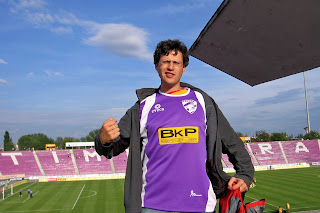 Geared up and ready for the match. "BkP" is Balkan Petroleum London, the team's major sponsor.
 The boys of Poli before the kickoff with Unirea Urziceni. Poli wound up winning 1-0 that evening. The gallery wasn't so big that day, but I was impressed nonetheless. Commando Viola Ultra Curva Sud. Check out the video clip:
 Attendance was around 5,000 that evening. Pretty good considering that the opponent wasn't of much interest. The stadium is packed when Steaua, Dinamo and Rapid come to town.
 April 1st, 2007, "America's number one Rapid fan"(as dubbed by his esteemed colleagues during an interview with Romania's Pro TV), undergoing pre-game preparation for the biggest derby of the season to date, Rapid vs. Steaua.
Rapid is my team. Of the three big Bucharest clubs, they're sort of the black sheep of the bunch. The stadium is in a not-so-nice part of town, and their fans are looked down upon by the elitist Dinamo and Steaua supporters, who don't hesitate to call them "gypsies". Rapid was founded as the rail workers club back in 1923 and its stadium is still owned by the Ministry of Transport. They're the blue collar team, a team with more history and tradition than Dinamo and Steaua, and have the most rabid and loyal fans.
Dinamo and Steaua were formed after communism took hold in the late 1940s. Dinamo was the securitate and police team and Steaua was the army team. These clubs both have a dubious past, as they used to apparently steal players at will from the other clubs, using threats of violence and intimidation. I've heard stories from the past of players and coaches being beaten and imprisoned for not doing the bidding of the thugs from Dinamo and Steaua. These days Dinamo is run by a psuedo-mafia conglomerate of "businessmen" and Steaua by one of Romania's most abhorrent personalities, Mr. George "Gigi" Becali. I love to watch Steaua lose and listen to Gigi whine about it during his infamous public tirades.
 That's right, I'm a season ticket holder.
 The One Man Invasion (OMI) showing us the way to Giulesti Stadium. A dream come true, two years in the making.
 The Giulesti Stadium Beer House. You know I'm gonna go.
 The OMI and Mr. Anderson. Forza Rapid, Muie Steaua!
 The OMI makes his long-awaited entrance into the gallery area of Giulesti stadium.
 Pre-game pose. We sat behind the north goal with the crazies, hooligans, superfans, or whatever you want to call them. We fit in perfectly. They're the cheap seats, but a whole lot of fun. See for yourself below...
 Hai Rapidul, Hai Rapidul , Haidei! Ole , ole, ole, ole, Rapid, Rapid!
 Most big clubs have a gallery leader, a superfan that leads the chants and cheers. His sound system is blasted into the gallery section and we are obliged to do his bidding. You don't want to get on his bad side.
I was fortunate to catch a couple of goals on video. The first clip is a goal by Cyril Thereau, a French national and forward for Steaua. He's one of the top scorers in Liga I. 1-0 Steaua.
This next clip is Rapid's second-half equalizer, an outstanding bicycle kick by Ianis Zicu, a member of the Romanian national team, in the 65th minute. 2-2 Rapid.
 Rapid lost that night, 2-3. It was up and down all night. Rapid gave up some stupid goals and should have won 2-1. To deal with the stress, everybody lit up, even the kids. They start them young here in Romania.
Depending on my schedule, I may or may not be able to attend some more games. No matter, as I've had a blast watching and talking soccer with the Romanians. I've definitely got the bug and will be frequenting the Chicago Fire matches for sure when I get home. Maybe one day I'll be able to see some big European clubs live at their home stadiums? 2010 World Cup in South Africa? All I know is that there's a lot of of "fotbal" to look forward to in the future.
As many loyal readers have probably figured out by now, I have become a big fan of soccer. I enjoyed and respected the game before I came to Romania, but it's different now. I understand it, I've seen it live at different levels of competition, I've lived through the ups and downs of a club season and national team competition, I've seen and felt the passion of the fans, etc. In short, I get it. Billions of fans can't be wrong. This American is convinced, soccer is indeed the world's game.
So, in this post I bring you some video and photo highlights of my soccer experience here in Romania, one aspect of my time here that I will truly miss. I'll have to get a Dish and Tivo. Dare to dream...
 The boys from the team at Hogas last year during an inter-school tournament in Piatra Neamt. They play a shortened, down-sized version of the game with less players on a concrete terrain that is a bit larger than a basketball court. It can be rough out there, with no real protection and bad footwear. I saw some pretty nasty scrapes that day out in front of the school.
 One of my former students, Mihai or Liviu, in action with the "gallery" watching in the background. As you may have noticed in the previous picture, he is one of a set of twins. I could never tell them apart, except for the fact that one of them was a goalkeeper. Both were great kids. Check out the action in the following video clip:
 Some die-hards cheering on my former hometown team, F.C. Ceahlaul Piatra Neamt. Ceahlaul competed in the 'B' Division during the '05-'06 season, thus attendance was sparse. However, they made the jump to 'Liga I' for the '06-'07 campaign and are now struggling to avoid demotion back to 'B' as they compete with the big boys like Steaua, Dinamo and Rapid. As a result of their promotion, their stadium received a major face lift and is now fit to host international competition. Romania hosted Luxembourg for a Euro 2008 qualifier there a few weeks ago and everything looked great. I barely recognized the place.
 Rough play or good acting? No matter, it's a yellow card for number 10 from Ceahlaul. 19 pleads his case in vain.
 FC Ceahaul action vs. FC Targoviste. Ceaulaul wound up winning that day.
 The old Ceahlaul logo. The club changed it after the jump to Liga I. This is unfortunate because they have a lot of tradition, dating back to 1919. Plus, I liked the old logo. It was unique. The new one is a bear or something. By the way, the club is named after the Ceahlaul Massif, a mountainous region in the area.
 Some soldiers on security detail. Who and/or what they're protecting is anybody's guess, as not many showed up for this game in May '06.
 Ceahlaul Stadium under the lights in May'06. As I mentioned earlier, the stadium has undergone major renovation. Thus, this view is a thing of the past.
 Football Club Brasov. As you can see, not a big draw. Nice stadium, no fans. They've been languishing in the 'B' Division for a few years now. Many are not pleased with this fact, as FC Brasov is a team with a lot of history and tradition. Combine this fact with the presence of the new upstart in town, Forex Brasov, a team that looks poised for promotion to Liga I, and, well, it's hard to put butts in the seats. Check out the following clip from their victory over F.C. Braila. Yawn.
 Great signs. I love that they're in English. "Come on Flag" has something to do with the former name of the club, which was associated with some sort of factory, "Steagul Rosie". Check out the "Mountain Sons" in the clip below, a 'B' division gallery in training. Not many of them, but they're having fun.
 Now that's loyalty.
 Dreaming of a return to Liga I...
 Alright, let's get down to business. September 2006, Dan Pelinescu stadium in Timisoara, capacity 30,000. One of the best stadiums in Liga I and home to F.C.U. Politechnica Timisoara, or better known as Poli Timisoara. Poli is my second favorite team and its fans are considered to be "brothers" with the fans of Rapid. If they're not playing Rapid, I root for Poli.
 Geared up and ready for the match. "BkP" is Balkan Petroleum London, the team's major sponsor.
 The boys of Poli before the kickoff with Unirea Urziceni. Poli wound up winning 1-0 that evening. The gallery wasn't so big that day, but I was impressed nonetheless. Commando Viola Ultra Curva Sud. Check out the video clip:
 Attendance was around 5,000 that evening. Pretty good considering that the opponent wasn't of much interest. The stadium is packed when Steaua, Dinamo and Rapid come to town.
 April 1st, 2007, "America's number one Rapid fan"(as dubbed by his esteemed colleagues during an interview with Romania's Pro TV), undergoing pre-game preparation for the biggest derby of the season to date, Rapid vs. Steaua.
Rapid is my team. Of the three big Bucharest clubs, they're sort of the black sheep of the bunch. The stadium is in a not-so-nice part of town, and their fans are looked down upon by the elitist Dinamo and Steaua supporters, who don't hesitate to call them "gypsies". Rapid was founded as the rail workers club back in 1923 and its stadium is still owned by the Ministry of Transport. They're the blue collar team, a team with more history and tradition than Dinamo and Steaua, and have the most rabid and loyal fans.
Dinamo and Steaua were formed after communism took hold in the late 1940s. Dinamo was the securitate and police team and Steaua was the army team. These clubs both have a dubious past, as they used to apparently steal players at will from the other clubs, using threats of violence and intimidation. I've heard stories from the past of players and coaches being beaten and imprisoned for not doing the bidding of the thugs from Dinamo and Steaua. These days Dinamo is run by a psuedo-mafia conglomerate of "businessmen" and Steaua by one of Romania's most abhorrent personalities, Mr. George "Gigi" Becali. I love to watch Steaua lose and listen to Gigi whine about it during his infamous public tirades.
 That's right, I'm a season ticket holder.
 The One Man Invasion (OMI) showing us the way to Giulesti Stadium. A dream come true, two years in the making.
 The Giulesti Stadium Beer House. You know I'm gonna go.
 The OMI and Mr. Anderson. Forza Rapid, Muie Steaua!
 The OMI makes his long-awaited entrance into the gallery area of Giulesti stadium.
 Pre-game pose. We sat behind the north goal with the crazies, hooligans, superfans, or whatever you want to call them. We fit in perfectly. They're the cheap seats, but a whole lot of fun. See for yourself below...
 Hai Rapidul, Hai Rapidul , Haidei! Ole , ole, ole, ole, Rapid, Rapid!
 Most big clubs have a gallery leader, a superfan that leads the chants and cheers. His sound system is blasted into the gallery section and we are obliged to do his bidding. You don't want to get on his bad side.
I was fortunate to catch a couple of goals on video. The first clip is a goal by Cyril Thereau, a French national and forward for Steaua. He's one of the top scorers in Liga I. 1-0 Steaua.
This next clip is Rapid's second-half equalizer, an outstanding bicycle kick by Ianis Zicu, a member of the Romanian national team, in the 65th minute. 2-2 Rapid.
 Rapid lost that night, 2-3. It was up and down all night. Rapid gave up some stupid goals and should have won 2-1. To deal with the stress, everybody lit up, even the kids. They start them young here in Romania.
Depending on my schedule, I may or may not be able to attend some more games. No matter, as I've had a blast watching and talking soccer with the Romanians. I've definitely got the bug and will be frequenting the Chicago Fire matches for sure when I get home. Maybe one day I'll be able to see some big European clubs live at their home stadiums? 2010 World Cup in South Africa? All I know is that there's a lot of of "fotbal" to look forward to in the future.
Friday, March 30, 2007
A Week on the Road, Part Four
Hi. I hope that you've enjoyed the "Week on the Road" post series. I now present to you the fourth and final part, my Ukrainian adventure...
Friday, February 9th
I woke up before my alarm rang, full of anticipation of the day that lie ahead. Julie and I decided that we'd cross the border into Ukraine on this day. Since the end of World War II it had been impossible to legally cross the border from Sighet. However, in mid-January of this year, just 3 weeks before my visit, President Traian Basescu of Romania and Ukrainian President Viktor Yuschenko met for a ribbon-cutting ceremony on the newly rebuilt bridge over the River Tisa (which had been bombed during the war), thus once again linking the 2 countries at this historic crossing point. I really had no idea what to expect. I didn't even know the name of the town across the border. All I knew was that I wanted to set my feet in uncharted territory.
The border crossing station was brand spanking new, with modern facilities manned by well-dressed, professional staff. We approached a border guard, told him that we wanted to cross and asked him if any other Americans had crossed at this location since the border opening. He informed us that we were numbers 4 and 5, as 3 had gone over in a car during the first week. However, we were to be the first Americans to cross on foot. Following a pleasant conversation and the obligatory passport stamping, we made our way onto the bridge and across the Tisa. Once we crossed the yellow dividing line pained on the bridge, things began to change.
It was foggy, cold and wet that day, so it was impossible to see the Ukrainian side until we were well past the dividing line. As we approached, the first thing I noticed was a large blue and yellow sign in cyrillic. Welcome to Ukraine - burly blond, blue-eyed border guards and sounds of a language I had only heard in movies and on television, etc. I was nervous and felt like I was in a kind of no man's land, a very foreign and potentially dangerous world, albeit for a few hours.
I tried to speak to the customs officer in English. That didn't go so well. We didn't fill out the entry form correctly. We fixed the problem and went back for a second try. As we made our way back to his area, I heard him speaking Romanian. What a relief. I politely apologized for not using Romanian in the first place and he seemed happy that he could now communicate with me. "Alright.", I thought, "This isn't going to be so difficult after all. He stamped my passport and I moved to the inspection area.
Things weren't so cordial at this stage. These guys didn't speak English or Romanian and were a bit thuggish. I emptied my pockets and put my camera and umbrella on the table. One said to me, "Bani". I looked at him, surprised, and said, "Bani?". "Money", he said. "Money?", I replied. "Euros, dollars, money", he stated firmly, gesturing so that I understood that he wanted to know if I was carrying any cash. Clearly these were the only words he new in English or Romanian, and important ones at that, no? I said, "Money? Yes, yes." He grinned and waited with anticipation, probably thinking I'd be easy pickings for a bribe. "I only have Romanian Lei", I said, and this was the truth. He stared me down for a bit and, disappointed, let me go. Clearly he was perplexed. How could the American "tourist" not be carrying Euros or Dollars? Score one for me.
Julie got through and off we went to the town of Solotvyna, or to the Romanians, Slatina, population 9,000 (approx.). At first glimpse, things didn't look much different than in Romania. However, as we walked further away from the border and deeper into the town, it became apparent that we had entered a different land. Poverty was more visible. The people looked even more worn-out and down-trodden than small-town Romanians. I geared up for the stares as we walked, and boy did we get them.
We observed that people were speaking Romanian on the streets, so I asked this old dude on a bike where the center of town was. With a thick Russian-like accent, he said to me, in Romanian, "this is the center of town". Ah. Okay, cool. The town center consisted of a Ukrainian Orthodox church (which was locked), a park in front of a Romanian-language school and a handful of shops and grocery stores/bars/cafeterias. I honestly believe, especially after talking to the shopkeepers and a couple of people on the street (80% speak Romanian), that we were the first Americans to ever take a stroll in "downtown" Slatina.
First stop was the ATM. We didn't know the exchange rate, so when posed with the decision as to how much money to withdraw, we hadn't a clue. Julie went first. She used her Romanian bankcard, an account containing only Lei. She took out 50 whatever-you-call-thems. I withdrew 100. We walked a bit further up the street and found a bank with exchange rates posted in the window. It was 5 to 1 Ukrainian/USD, so that meant it was roughly 2.5 to 1 Ukrainian/Lei. That being said, stuff was cheap.
We checked out a few stores, one of which had goods strewn about the floor in crates and a long line of old women in babushkas waiting silently to buy their groceries. The place smelled like wet, moldy socks. It was a scene straight out of the Soviet Union. Needless to say, we got the hell out of there and found a better smelling and more professional looking operation. I bought some chocolate. One bar with Red Square on it and another with a Ukrainian peasant girl named Alionka. We found another grocery store. This one had a bar with two beer taps and some tables and chairs. Score.
The barman/owner couldn't believe that 1) there were Americans in his establishment and 2) that we spoke Romanian. I had to show him my passport to convince him. Suspicions now set aside (sort of), he set us up with a couple of pints of solid Rogan lager, some stale bread and bowls of Ukrainian borscht. The borscht wasn't much different than certain kinds of Romanian soups. It contained beets, carrots, cabbage, potatoes, beef, oil and a dollop of sour cream. It was your standard Ukrainian borscht. As we ate, one by one people would come in, sit down and start to whisper and look at us. When we we getting ready to leave, someone got up the courage to speak to us. We conversed in Romanian with the owner, the cook and some others. We told them who we were and where we came from. They were incredulous. Really. We must have been the first Americans they had ever seen and/or spoken to in person. We bought some beers to take back with us, hit the road and headed across the park to the school.
Of course, we just walked in. We didn't see any teachers and the few kids we saw in the halls simply stared, whispered and giggled. We felt right at home. The halls were cold, drab and empty. We went up to to the third floor and peered out a window looking out onto the back courtyard. There was a wheelbarrow and shovel parked next to a HUGE pile of coal, out in the open. Obviously this was the school's source of heat and, hopefully, a disciplinary tool. I certainly would love to make some of my little darlings go out to the back of the school and shovel coal if they've been misbehaving. Damn natural gas. I should have done PC Ukraine. Seriously though, it was all so surreal, I felt like I was in a time warp. After seeing the coal pile, we realized that the strange smell that hung in the air was from the plethora of coal-burning furnaces in town. Romanians use wood as an alternative to natural gas. I've never encountered any houses or buildings here that burn coal for heat.
Our final stop was a liquor store. The woman inside was super friendly and spoke Romanian without a heavy accent. I said I wanted a bottle of something "very Ukrainian" to take back with me, something akin to the national drink. She smiled and pulled a bottle off the shelf. Nemiroff Vodka with hot peppers floating in it and a touch of honey. Hot and sweet vodka. Nice. I'll take it. The 750 ml bottle cost me about the equivalent of US $3.50. What a deal. We talked a bit about the town and she encouraged us to come back and visit the museum. I could only imagine what that's like. We got some info. about transport to Kiev and Lviv, as I was curious about travel times to these cities. They were entirely too long of course. We exchanged pleasantries and said goodbye. Again, it was so great that we were able to communicate with people in town. We only encountered two people that day who didn't speak Romanian, one of whom only spoke Hungarian!
On our way back to the border we came across a Ukrainian television crew interviewing people as they came in from Romania. I had to get back across the border, as I still had to pack and catch a train later that afternoon, but I couldn't resist the chance to speak with them. I approached them, and in Romanian said, "Hi, we're Americans". The looks on their faces were priceless. They paused, stared, and after regaining their wits motioned excitedly for us to come talk to them. They interviewed Julie and I for about 10 minutes. The television audience probably had never seen anything like it. Two Americans, out for a day of shopping and sightseeing in Slatina during the dead of winter, speaking Romanian on a Ukrainian news broadcast. Awesome. Julie and I were true pioneers that day. And back we went with sacks full of beer, vodka and chocolate, problem and hassle-free.
I hopped on the train back to Brasov around 5:30pm. It was a night train that got in around 4am. I shared a sleeper cabin with some gypsy dude from Bucharest, a perfume salesman/smuggler. It was a furnace in that compartment. We were burning up. The gypsy dude couldn't take it anymore and had to take his shirt off. He smelled, and the whole trip was pretty awful. Just another day on the CFR (Romanian Railways).
What a trip. I saw and experienced things that were truly new and unique to me, things that most Americans never do. I want to go back to Maramures someday and explore the villages when the weather is nice. I also must go back to Ukraine, maybe to Lviv or Kiev and definitely to Slatina. Most of all, I want to go back to that liquor store and grocery/bar and chat with all of the friendly Ukrainians I met that day. They changed my world, my perspective, and I think we did the same for them. They're going to see more and more visitors from the West as spring and summer comes. The new border crossing is going to change their lives in a big way. I hope that they never forget us, the Romanian-speaking Americans who came to Slatina one rainy winter day in February. I'll surely never forget them.
 The border crossing at Sighet.
 Julie can't believe that she's about to leave "home". Yes, the former Soviet Union is just across that bridge.
 The mighty river Tisa.
 Welcome to Ukraine comrade.
 Borscht and beer. Hits the spot on a cold, rainy winter afternoon in Ukraine.
 Welcome to the Romanian school. I should have taken a photo of the coal pile out back. That was the one that got away.
 This was on the wall in the hallway. I believe that this is something about Maramures, based on the costumes and hay bales. However, I do not read cyrillic.
 I liked this one. Maybe something about the good 'ole Red Army?
 In the park with some sort of Soviet-era WW-II memorial. My Belarussian blood compelled me to salute.
 Shopping bag full, Julie's ready to go back across. But not before...
 ...we talk to the TV crew. Check out their cool little Lada 4x4 in the background.
 The border approach, Ukrainian side.
 Yes, I really was there.
 Yes, I took out too much currency. But check out my cool "wallet".
 Back home in Codlea with Alionka and Nemiroff.
Friday, February 9th
I woke up before my alarm rang, full of anticipation of the day that lie ahead. Julie and I decided that we'd cross the border into Ukraine on this day. Since the end of World War II it had been impossible to legally cross the border from Sighet. However, in mid-January of this year, just 3 weeks before my visit, President Traian Basescu of Romania and Ukrainian President Viktor Yuschenko met for a ribbon-cutting ceremony on the newly rebuilt bridge over the River Tisa (which had been bombed during the war), thus once again linking the 2 countries at this historic crossing point. I really had no idea what to expect. I didn't even know the name of the town across the border. All I knew was that I wanted to set my feet in uncharted territory.
The border crossing station was brand spanking new, with modern facilities manned by well-dressed, professional staff. We approached a border guard, told him that we wanted to cross and asked him if any other Americans had crossed at this location since the border opening. He informed us that we were numbers 4 and 5, as 3 had gone over in a car during the first week. However, we were to be the first Americans to cross on foot. Following a pleasant conversation and the obligatory passport stamping, we made our way onto the bridge and across the Tisa. Once we crossed the yellow dividing line pained on the bridge, things began to change.
It was foggy, cold and wet that day, so it was impossible to see the Ukrainian side until we were well past the dividing line. As we approached, the first thing I noticed was a large blue and yellow sign in cyrillic. Welcome to Ukraine - burly blond, blue-eyed border guards and sounds of a language I had only heard in movies and on television, etc. I was nervous and felt like I was in a kind of no man's land, a very foreign and potentially dangerous world, albeit for a few hours.
I tried to speak to the customs officer in English. That didn't go so well. We didn't fill out the entry form correctly. We fixed the problem and went back for a second try. As we made our way back to his area, I heard him speaking Romanian. What a relief. I politely apologized for not using Romanian in the first place and he seemed happy that he could now communicate with me. "Alright.", I thought, "This isn't going to be so difficult after all. He stamped my passport and I moved to the inspection area.
Things weren't so cordial at this stage. These guys didn't speak English or Romanian and were a bit thuggish. I emptied my pockets and put my camera and umbrella on the table. One said to me, "Bani". I looked at him, surprised, and said, "Bani?". "Money", he said. "Money?", I replied. "Euros, dollars, money", he stated firmly, gesturing so that I understood that he wanted to know if I was carrying any cash. Clearly these were the only words he new in English or Romanian, and important ones at that, no? I said, "Money? Yes, yes." He grinned and waited with anticipation, probably thinking I'd be easy pickings for a bribe. "I only have Romanian Lei", I said, and this was the truth. He stared me down for a bit and, disappointed, let me go. Clearly he was perplexed. How could the American "tourist" not be carrying Euros or Dollars? Score one for me.
Julie got through and off we went to the town of Solotvyna, or to the Romanians, Slatina, population 9,000 (approx.). At first glimpse, things didn't look much different than in Romania. However, as we walked further away from the border and deeper into the town, it became apparent that we had entered a different land. Poverty was more visible. The people looked even more worn-out and down-trodden than small-town Romanians. I geared up for the stares as we walked, and boy did we get them.
We observed that people were speaking Romanian on the streets, so I asked this old dude on a bike where the center of town was. With a thick Russian-like accent, he said to me, in Romanian, "this is the center of town". Ah. Okay, cool. The town center consisted of a Ukrainian Orthodox church (which was locked), a park in front of a Romanian-language school and a handful of shops and grocery stores/bars/cafeterias. I honestly believe, especially after talking to the shopkeepers and a couple of people on the street (80% speak Romanian), that we were the first Americans to ever take a stroll in "downtown" Slatina.
First stop was the ATM. We didn't know the exchange rate, so when posed with the decision as to how much money to withdraw, we hadn't a clue. Julie went first. She used her Romanian bankcard, an account containing only Lei. She took out 50 whatever-you-call-thems. I withdrew 100. We walked a bit further up the street and found a bank with exchange rates posted in the window. It was 5 to 1 Ukrainian/USD, so that meant it was roughly 2.5 to 1 Ukrainian/Lei. That being said, stuff was cheap.
We checked out a few stores, one of which had goods strewn about the floor in crates and a long line of old women in babushkas waiting silently to buy their groceries. The place smelled like wet, moldy socks. It was a scene straight out of the Soviet Union. Needless to say, we got the hell out of there and found a better smelling and more professional looking operation. I bought some chocolate. One bar with Red Square on it and another with a Ukrainian peasant girl named Alionka. We found another grocery store. This one had a bar with two beer taps and some tables and chairs. Score.
The barman/owner couldn't believe that 1) there were Americans in his establishment and 2) that we spoke Romanian. I had to show him my passport to convince him. Suspicions now set aside (sort of), he set us up with a couple of pints of solid Rogan lager, some stale bread and bowls of Ukrainian borscht. The borscht wasn't much different than certain kinds of Romanian soups. It contained beets, carrots, cabbage, potatoes, beef, oil and a dollop of sour cream. It was your standard Ukrainian borscht. As we ate, one by one people would come in, sit down and start to whisper and look at us. When we we getting ready to leave, someone got up the courage to speak to us. We conversed in Romanian with the owner, the cook and some others. We told them who we were and where we came from. They were incredulous. Really. We must have been the first Americans they had ever seen and/or spoken to in person. We bought some beers to take back with us, hit the road and headed across the park to the school.
Of course, we just walked in. We didn't see any teachers and the few kids we saw in the halls simply stared, whispered and giggled. We felt right at home. The halls were cold, drab and empty. We went up to to the third floor and peered out a window looking out onto the back courtyard. There was a wheelbarrow and shovel parked next to a HUGE pile of coal, out in the open. Obviously this was the school's source of heat and, hopefully, a disciplinary tool. I certainly would love to make some of my little darlings go out to the back of the school and shovel coal if they've been misbehaving. Damn natural gas. I should have done PC Ukraine. Seriously though, it was all so surreal, I felt like I was in a time warp. After seeing the coal pile, we realized that the strange smell that hung in the air was from the plethora of coal-burning furnaces in town. Romanians use wood as an alternative to natural gas. I've never encountered any houses or buildings here that burn coal for heat.
Our final stop was a liquor store. The woman inside was super friendly and spoke Romanian without a heavy accent. I said I wanted a bottle of something "very Ukrainian" to take back with me, something akin to the national drink. She smiled and pulled a bottle off the shelf. Nemiroff Vodka with hot peppers floating in it and a touch of honey. Hot and sweet vodka. Nice. I'll take it. The 750 ml bottle cost me about the equivalent of US $3.50. What a deal. We talked a bit about the town and she encouraged us to come back and visit the museum. I could only imagine what that's like. We got some info. about transport to Kiev and Lviv, as I was curious about travel times to these cities. They were entirely too long of course. We exchanged pleasantries and said goodbye. Again, it was so great that we were able to communicate with people in town. We only encountered two people that day who didn't speak Romanian, one of whom only spoke Hungarian!
On our way back to the border we came across a Ukrainian television crew interviewing people as they came in from Romania. I had to get back across the border, as I still had to pack and catch a train later that afternoon, but I couldn't resist the chance to speak with them. I approached them, and in Romanian said, "Hi, we're Americans". The looks on their faces were priceless. They paused, stared, and after regaining their wits motioned excitedly for us to come talk to them. They interviewed Julie and I for about 10 minutes. The television audience probably had never seen anything like it. Two Americans, out for a day of shopping and sightseeing in Slatina during the dead of winter, speaking Romanian on a Ukrainian news broadcast. Awesome. Julie and I were true pioneers that day. And back we went with sacks full of beer, vodka and chocolate, problem and hassle-free.
I hopped on the train back to Brasov around 5:30pm. It was a night train that got in around 4am. I shared a sleeper cabin with some gypsy dude from Bucharest, a perfume salesman/smuggler. It was a furnace in that compartment. We were burning up. The gypsy dude couldn't take it anymore and had to take his shirt off. He smelled, and the whole trip was pretty awful. Just another day on the CFR (Romanian Railways).
What a trip. I saw and experienced things that were truly new and unique to me, things that most Americans never do. I want to go back to Maramures someday and explore the villages when the weather is nice. I also must go back to Ukraine, maybe to Lviv or Kiev and definitely to Slatina. Most of all, I want to go back to that liquor store and grocery/bar and chat with all of the friendly Ukrainians I met that day. They changed my world, my perspective, and I think we did the same for them. They're going to see more and more visitors from the West as spring and summer comes. The new border crossing is going to change their lives in a big way. I hope that they never forget us, the Romanian-speaking Americans who came to Slatina one rainy winter day in February. I'll surely never forget them.
Photo Highlights
 The border crossing at Sighet.
 Julie can't believe that she's about to leave "home". Yes, the former Soviet Union is just across that bridge.
 The mighty river Tisa.
 Welcome to Ukraine comrade.
 Borscht and beer. Hits the spot on a cold, rainy winter afternoon in Ukraine.
 Welcome to the Romanian school. I should have taken a photo of the coal pile out back. That was the one that got away.
 This was on the wall in the hallway. I believe that this is something about Maramures, based on the costumes and hay bales. However, I do not read cyrillic.
 I liked this one. Maybe something about the good 'ole Red Army?
 In the park with some sort of Soviet-era WW-II memorial. My Belarussian blood compelled me to salute.
 Shopping bag full, Julie's ready to go back across. But not before...
 ...we talk to the TV crew. Check out their cool little Lada 4x4 in the background.
 The border approach, Ukrainian side.
 Yes, I really was there.
 Yes, I took out too much currency. But check out my cool "wallet".
 Back home in Codlea with Alionka and Nemiroff.
Subscribe to:
Posts (Atom)


